

Key points
Annual statistics
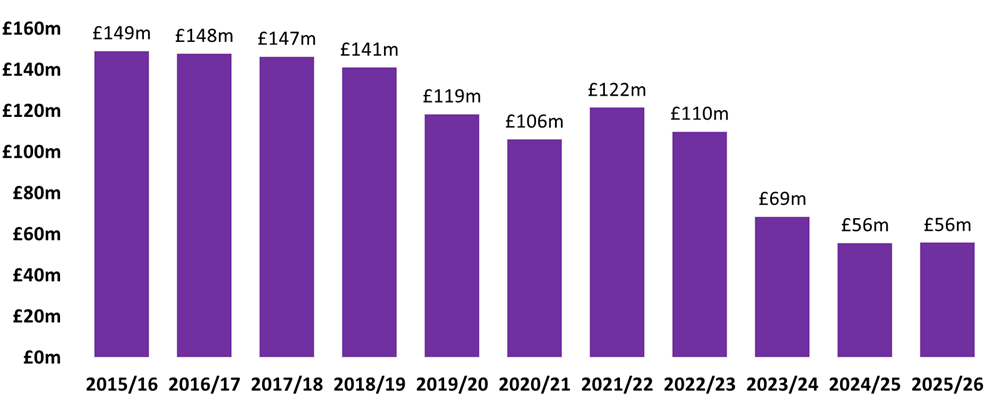
- In 2025/26 net Scottish Landfill Tax (SLfT) declared due was £56.0 million, a 0.2% increase on the previous year. The long-term decrease in net SLfT, excepting the increase in 2021/22, is mainly due to standard rate disposal tonnages decreasing faster than the standard rate of tax has increased. The slight increase in net SLfT compared with 2024/25 is due to the standard rate per tonne increasing from £103.70 to £126.15 in April 2025.
- Standard rate disposals account for the vast majority of SLfT due, making up 97% of gross SLfT in 2025/26. Both standard and lower rate tonnages were at their lowest ever annual totals, at 451,700 tonnes and 382,000 tonnes respectively. Standard rate disposals make up most of the SLfT due because the standard tax rate is around 31 times higher than the lower tax rate.
- In 2025/26 almost half of SLfT revenue (48.6%) was from Mixed municipal waste (EWC code 20 03 01), followed by 24.4% from EWC code 19 12 12 (waste “from the mechanical treatment of waste”). Other or unknown types of waste made up the remaining 27%.
Quarterly statistics
- £8.5 million in Scottish Landfill Tax (SLfT) was declared payable Q4 2025/26 (January to March 2026). Total standard rate tonnage was 67,200 and total lower rate tonnage was 108,500.
- The total SLfT declared due and both standard and lower rate waste decreased in Q4 compared to Q3.
- 23 operators provided returns for the latest quarter, covering 41 sites. Note that some sites may submit a nil return for some quarters as operators are liable to submit a return until they are de-registered.
Introduction
This publication is part of a quarterly series of Scottish Landfill Tax (SLfT) statistics, started in April 2015, which provides data on the total number of returns; total number of sites; total tax payable; total contributions to the Scottish Landfill Communities Fund; standard and lower rate waste tonnages, as reported to Revenue Scotland.
We have amended this publication to include annual summary information and additional breakdowns by European Waste Catalogue (EWC) code which were previously only included in our annual statistics publication.
We have published a document covering SLfT background information, data sources, methodology, quality, revisions policy and corrections.
An Official Statistics Publication for Scotland
These statistics are official statistics. Official statistics are statistics that are produced by crown bodies, those acting on behalf of crown bodies, or those specified in statutory orders, as defined in the Statistics and Registration Service Act 2007.
Revenue Scotland statistics are regulated by the Office for Statistics Regulation (OSR). OSR sets the standards of trustworthiness, quality and value in the Code of Practice for Statistics that all producers of official statistics should adhere to.
Annual statistics
The following annual statistics used to be published in our Annual Summary of Trends in the Devolved Taxes. They are now being published as part of our Q4 quarterly SLfT statistics to improve timeliness of release and more detailed statistics for users. The Annual Statistics Publication will be no longer be published and is being replaced by these annual SLfT statistics and a separate new publication for annual trends in Land and Buildings Transaction Tax (LBTT).
SLfT declared and tonnages by year
SLfT was £56.0 million during 2025/26, 0.2% higher than the previous year (£55.9m).
Figure 1: Column chart showing SLfT declared by year from 2015/16 to 2025/26, with a decreasing trend after 2021/22.
Standard and lower rate tonnages were both lower in 2025/26 than last year.
Figure 2: Line chart showing standard and lower rate tonnages by quarter. Standard rate shows a decreasing trend through time.
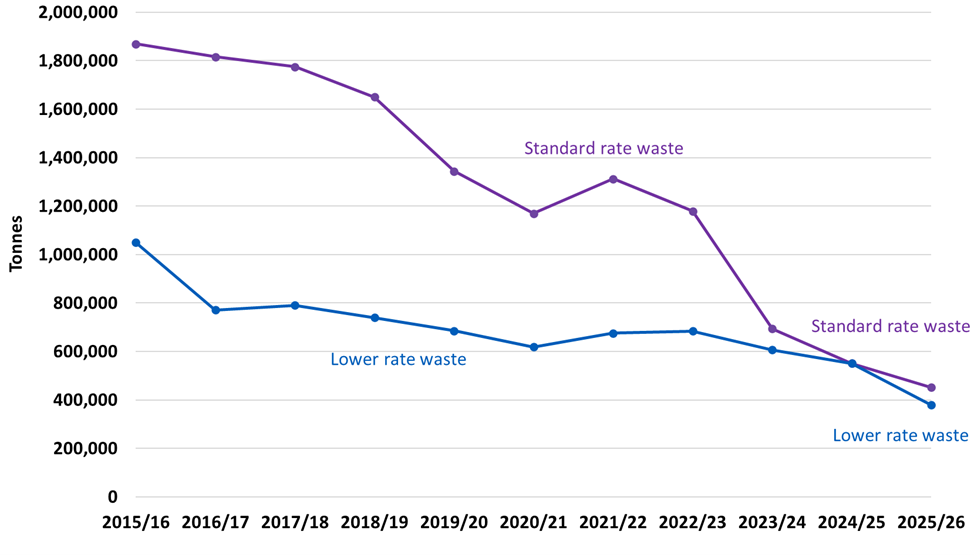
In 2025/26 net SLfT declared due was £56.0 million, a 0.2% increase on the previous year. The long-term decrease in net SLfT, with the exception of 2021/22, is mainly due to a long term decrease in waste disposals at landfill sites. The tax rates on SLfT have meanwhile risen over this period – view the historic rates. The standard rate increased from £103.70 to £126.15 in April 2025, which accounts for the slight increase in net SLfT in 2025/26 despite standard rate tonnage decreasing by 18%.
Standard rate disposals account for the vast majority of SLfT due, making up 97% of gross SLfT in 2025/26. Standard rate disposals make up most of the SLfT due because the standard tax rate is around 31 times higher than the lower tax rate.
European Waste Catalogue (EWC) codes by year
European Waste Catalogue (EWC) codes are a coding system used to describe and categorise waste. More information on the waste codes can be found in SEPA’s Guidance on using the European Waste Catalogue (EWC) to code waste document.
Mixed municipal waste (EWC code 20 03 01) is the most prevalent waste type, contributing almost half of SLfT revenue in 2025/26 (48.6%). A further 24.4% was attributable to disposals of EWC code 19 12 12, which constitutes waste “from the mechanical treatment of waste” (meaning it will contain other waste EWC codes waste types that have then been mechanically treated). Disposals of these two waste streams have accounted for the majority of gross SLfT declared due each year. The remaining 27.0% of SLfT is attributable to Other or unknown waste codes.
Mixed municipal waste has accounted for nearly 8 million tonnes of taxable disposals since 2015/16, nearly all of which was subject to the standard rate of SLfT. Total tonnages of this waste code have been falling over time, reaching the lowest level to date in 2025/26 (225,300 tonnes).
EWC code 19 12 12 has accounted for approximately 6.5 million tonnes of taxable disposals since 2015/16. The total tonnage of this waste code increased from 2015/16 to 2022/23, but has decreased over the last two years reaching the lowest level to date in 2025/26 (237,500 tonnes).
The composition of standard and lower rate waste is different. Standard rate waste is predominantly EWC code 20 03 01 (49.9% of standard rate gross SLfT in 2025/26). Lower rate waste is largely EWC code 19 12 12 (33.6% of lower rate gross SLfT in 2024/25). EWC code 17 05 04 (soil and stones other than those mentioned in 17 05 03) made up 13.8% of lower rate tonnage in the past year and EWC code 19 12 09 (minerals for example sand, stones) accounted for 11.8% of lower rate tonnage. In 2025/26 40.8% of lower rate tonnage fell into the “Other or unknown category”.
Quarterly statistics
SLfT declared by quarter
SLfT was £8.5 million during the last quarter, £2.8 million (25%) lower than the previous quarter (£11.3m).
Figure 3: Column chart showing SLfT declared by quarter from 2015/16 to 2025/26, with a decreasing trend through time. An additional line shows the 4 quarter moving average for SLfT declared due.
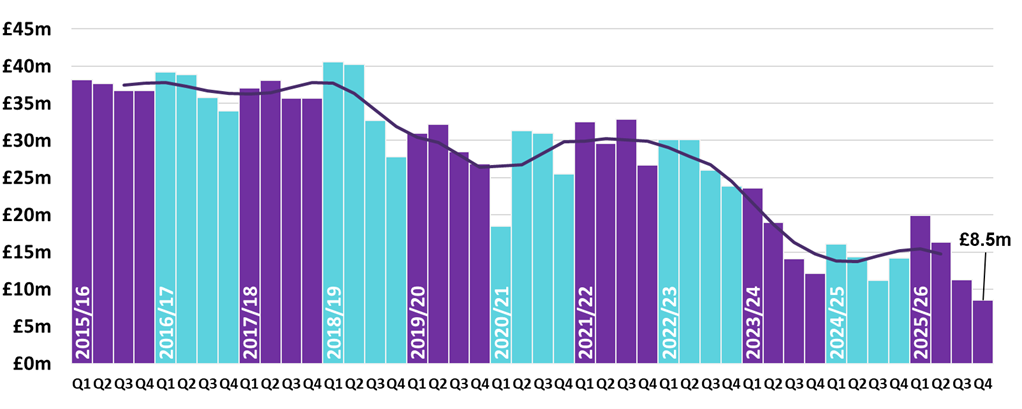
The total SLfT declared due and standard rate waste decreased by 25% in the last quarter to £8.5m, the lowest figure for any quarter since the introduction of SLfT.
Tonnage by quarter
Standard rate tonnage was 28% lower than the previous quarter and lower rate tonnage was 58% higher.
Figure 4: Line chart showing standard and lower rate tonnages by quarter.
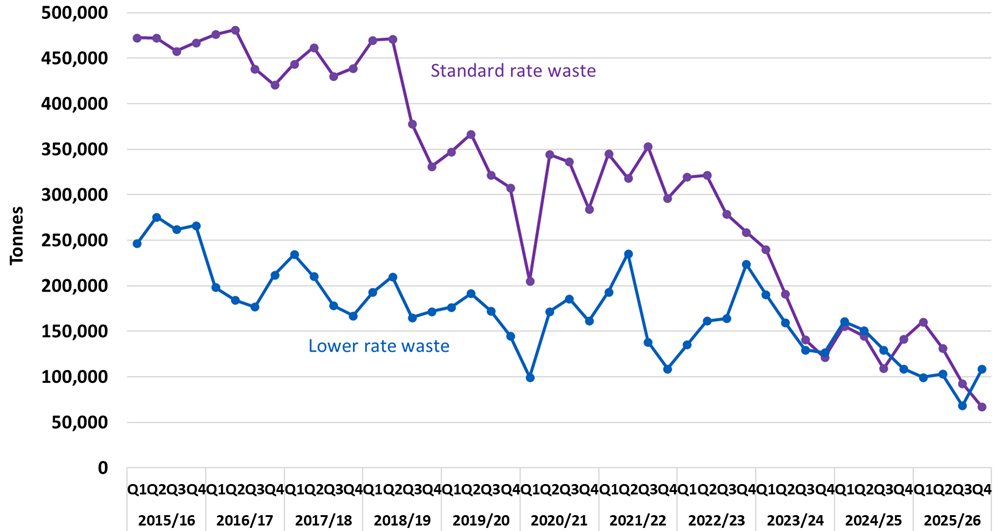
Standard rate tonnage in Q4 of 2025/26 was 67,200, the lowest of any quarter since reporting began in 2015. Lower rate tonnage was 108,500, which is the lowest for any Q4.
Background to SLfT
Scottish Landfill Tax (SLfT) is a tax on the disposal or unauthorised disposal of waste to landfill and is charged by weight. SLfT is a devolved tax, replacing UK landfill tax in Scotland only from 1 April 2015.
- A document covering SLfT background information, data sources, methodology, quality, revisions policy and corrections
- Further information about Scottish Landfill Tax and the Scottish Landfill Communities Fund.
Tell us what you think
We are always interested to hear from our users about how our statistics are used, and how they can be improved.
Enquiries
For enquiries about this publication please contact:
statistics@revenue.scot