
1. Statement of accounting policies
1.1. Basis of accounting
In accordance with the accounts direction issued by the Scottish Ministers under section 19(4) of the Public Finance and Accountability (Scotland) Act 2000, these financial statements have been prepared in accordance with the 2025-26 Government Financial Reporting Manual (FReM), issued by HM Treasury. The accounting policies contained in the FReM apply International Financial Reporting Standards (IFRS) as adapted or interpreted for the public sector context. The accounting policies have been applied consistently in dealing with items considered material in relation to the accounts.
The income and associated expenditure contained within these statements are those flows of funds which Revenue Scotland handles on behalf of the Scottish Consolidated Fund and where it is acting as agent rather than principal.
The Devolved Taxes Accounts have been prepared on a going concern basis, which provides that the organisation will continue in operational existence for the foreseeable future.
1.2. Accounting convention
The Devolved Taxes Accounts have been prepared in accordance with the historical cost convention. Taxes (including repayments) are accounted for on an accruals basis and where necessary, estimation techniques have been selected as the most appropriate for the purpose of giving a true and fair view in accordance with the principles set out in International Accounting Standard (IAS) 8 Accounting Policies, Changes in Accounting Estimates and Errors.
Critical accounting judgements and key sources of estimation
The preparation of financial statements in accordance with IFRS requires the use of certain accounting estimates. It also requires management to exercise judgement in the process of applying accounting policies. For the Devolved Taxes Accounts the significant assumptions and estimates are set out in the accounting policies and/or notes to the accounts. 31 May has been used as the cut-off point for accrual purposes.
1.3. New accounting standards
In accordance with IAS 8: Accounting Policies, Changes in Accounting Estimates and Errors, changes to International Financial Reporting Standards (IFRS) that have been issued but not yet effective have been reviewed for impact on the financial statements in the period of initial application. There are no updates to the standards that are considered to be relevant to Revenue Scotland’s Devolved Taxes Account. IFRS17 (Insurance Contracts) replaced IFRS 4 (Insurance Contracts) and was effective in 2025- 26. It did not impact on the 2025-26 Devolved Taxes Accounts.
IFRS 18 Presentation and Disclosure in Financial Statements replaces IAS 1 Presentation of Financial Statements and is effective for annual reporting periods beginning on or after 1 January 2027. The impact of IFRS 18 on the public sector continues to be assessed and, at the reporting date, no implementation date had been confirmed for the UK public sector.
1.4. The tax gap
The tax gap is not recognised in the Devolved Taxes Account. The tax gap is the difference between the amount of tax that should, in theory, be collected by Revenue Scotland (the theoretical liability), against what is actually collected. The theoretical liability represents the tax that would have been paid if all individuals and companies complied with both the letter of the law and Revenue Scotland’s interpretation of the intention of the Scottish Parliament in setting law (referred to as the spirit of the law). Revenue Scotland undertakes compliance work in order to limit the tax gap.
1.5. Financial instruments
Revenue Scotland collects tax revenue on behalf of the Scottish Ministers for the Scottish Consolidated Fund, therefore financial instruments play a limited role in creating and managing risk. The only financial instruments within the accounts are financial assets in the form of receivables and financial liabilities in the form of payables.
1.6. Revenue recognition – Taxation
Taxes are measured in accordance with IFRS 15: Revenue from Contracts with Customers. They are measured at the fair value of amounts received or receivable, net of repayments.
Revenue is recognised when:
- a taxable event has occurred, the revenue can be measured reliably and it is probable that the economic benefits from the taxable event will flow to the Scottish Consolidated Fund.
A taxable event therefore occurs when a liability arises to pay a tax.
Repayments of Additional Dwelling Supplement are recognised when the taxpayer or agent submits a claim for repayment creating an obligating event, and the sale of the previous main residence falls within the reported financial year or earlier.
1.7. Revenue recognition – Penalties and Interest
Penalties and interest are measured in accordance with IFRS 15. They are measured at the fair value of amounts received or receivable. Revenue is recognised when:
- a penalty or interest charge is validly imposed and an obligation to pay arises.
Penalty and interest revenue is de-recognised:
- when a penalty is cancelled following the correction of a tax return arising from a minor error by the taxpayer or agent
- where a penalty is cancelled following a review by Revenue Scotland; and
- where a taxpayer’s appeal against the penalty is upheld by the Scottish Tribunals.
Where penalty and interest revenue has been previously recognised and is later deemed uncollectable for reasons other than those shown above, this is recorded as an expense at the date of the decision.
1.8. Contingent assets
IAS 37: Provisions, Contingent Liabilities and Contingent Assets, defines a Contingent Asset as a possible asset, whose existence will be confirmed only by the occurrence or non-occurrence of one or more uncertain future events not wholly within the entity’s control. Contingent assets often cannot be reliably quantified; where values can be determined these have been provided. Contingent assets are not recognised within the Statement of Revenue and Expenditure or Statement of Financial Position but are disclosed as notes within Revenue Scotland’s accounts.
1.9. Contingent liabilities
IAS 37: Provisions, Contingent Liabilities and Contingent Assets, defines a Contingent Liability as a possible liability, whose existence will be confirmed only by the occurrence or non-occurrence of one or more uncertain future events not wholly within the entity’s control. Contingent liabilities often cannot be reliably quantified; where values can be determined these have been provided. Contingent liabilities are not recognised within the Statement of Revenue and Expenditure or Statement of Financial Position but are disclosed as notes within Revenue Scotland’s accounts.
1.10. Receivables
Revenue Scotland determines impairments in accordance with IFRS 9: Financial Instruments. Impairments have been measured by applying the credit loss model set out in IFRS 9. The impairment model in IFRS 9 is based on the premise of providing for expected losses utilising available information and considering the probability of collection.
2. Revenue and other income
2.1. Taxes
| 2025-26 £'000 |
2024-25 £'000 |
|
|---|---|---|
| Land & Buildings Transaction Tax | ||
| Residential | 522,389 | 485,450 |
| Non-residential | 230,732 | 233,972 |
| Additional Dwelling Supplement (ADS) | 293,265 | 257,789 |
| Repayment of ADS | (94,347) | (78,049) |
| Total Land & Buildings Transaction Tax | 952,039 | 899,162 |
| Scottish Landfill Tax | 55,478 | 55,938 |
| Total | 1,007,517 | 955,100 |
Land and Buildings Transaction Tax is payable on the acquisition of a chargeable interest in, or over, land in Scotland. Additional Dwelling Supplement (ADS) is payable on the purchase of additional residential properties in Scotland. It is repayable where the taxpayer’s previous main residence is sold and the qualifying conditions are met. Scottish Landfill Tax is payable on disposals of waste material in Scotland made by way of landfill.
2.2. Penalties and interest
| Year penalty incurred | 2025-26 Penalty £000 |
2025-26 Interest £000 |
2025-26 Total £000 |
2024-25 Penalty £000 |
2024-25 Interest £000 |
2024-25 Total £000 |
|
|---|---|---|---|---|---|---|---|
| Land and Buildings Transaction Tax | 2025-26 | 533 | 62 | 595 | |||
| 2024-25 | 195 | 44 | 239 | 568 | 70 | 638 | |
| 2023-24 | 685 | 31 | 716 | 57 | 67 | 124 | |
| Pre 2023 | 3,042 | 386 | 3,428 | 4,381 | 489 | 4,870 | |
| Total | 4,455 | 523 | 4,978 | 5,006 | 626 | 5,632 | |
| Scottish Landfill Tax | 2025-26 | 169 | 22 | 191 | |||
| 2024-25 | 185 | 138 | 323 | 439 | 79 | 518 | |
| 2023-24 | 0 | 0 | 0 | 135 | 172 | 307 | |
| Pre 2023 | 0 | 0 | 0 | 0 | 0 | 0 | |
| Total | 354 | 160 | 514 | 574 | 251 | 825 | |
| Total penalties | 4,809 | 683 | 5,492 | 5,580 | 877 | 6,457 |
Penalties are charged on the late receipt of tax returns, late payments or other reasons permitted under the RSTPA. Penalties are recognised when a penalty notice has been issued to the taxpayer. Interest is charged on the late payment of tax returns or penalties.
3. Expenditure
3.1. Interest paid
| 2025-26 £’000 |
2024-25 £’000 |
|
|---|---|---|
| Land and Buildings Transaction Tax | 2,606 | 2,544 |
| Scottish Landfill Tax | 0 | 4 |
| Total Interest paid | 2,606 | 2,548 |
Interest is payable by Revenue Scotland on the repayment of any tax or penalties.
3.2. Revenue losses
| Debts written off Total £'000 |
Increase/ (decrease) in impairments Total £'000 |
2025-26 Total £'000 |
2024-25 Total £'000 |
|
|---|---|---|---|---|
| Land and Buildings Transaction Tax | 2,058 | 1,157 | 3,215 | 1,417 |
| Scottish Landfill Tax | 0 | 5,079 | 5,079 | 5,039 |
| Total | 2,058 | 6,236 | 8,294 | 6,456 |
Revenue losses and gains are made up of revenue write-offs and the movement in the impairment of receivables (further information can be found in Note 4.2 Change to impairments).
Debts written off are amounts that, after all reasonable action has been taken and following careful appraisal, have been considered to be irrecoverable or are no longer economic to collect. Impairment reflects the prospects of recovery in relation to debt recovery action.
4. Receivables
4.1. Amounts due
| Receivables £'000 |
Accrued Revenue Receivable £'000 |
2025-26 Total £'000 |
2024-25 Total £'000 |
|
|---|---|---|---|---|
| Land & Buildings Transaction Tax | 17,148 | 14,210 | 31,358 | 42,382 |
| Scottish Landfill Tax | 11,427 | 7,609 | 19,035 | 24,022 |
| Totals before impairments | 28,575 | 21,819 | 50,393 | 66,404 |
| Less impairments (see note) | (15,532) | (15,532) | (9,296) | |
| Total | 13,043 | 21,819 | 34,861 | 57,108 |
Receivables represents taxpayer liabilities where a liability has been assessed and not paid at the date of the statement of financial position, including amounts due from those on whom financial penalties have been imposed prior to, but not paid at that date. Accrued Revenue Receivable represents taxpayer liabilities which relate to the financial year but for which the liability had not been assessed as at the date of the Statement of Financial Position. These may include estimates made by Revenue Scotland of those activities.
4.2. Change to impairments
| LBTT £000 | SLFT £000 | 2025-26 Total £000 | 2024-25 Total £000 | |
|---|---|---|---|---|
| Balance at 1 April | 4,257 | 5,039 | 9,296 | 2,839 |
| Change in estimated value of impairments (Note 3.2) | 1,157 | 5,079 | 6,236 | 6,457 |
| Balance at 31 March | 5,414 | 10,118 | 15,532 | 9,296 |
Impairments are debts which are currently being pursued but which are considered likely to be irrecoverable in the longer term. Receivables in the Statement of Financial Position are reported after the deduction of the estimated value of impairments. The estimate is based on a number of factors including where legal action has been initiated.
5. Cash
| 2025-26 Total £000 |
2024-25 Total £000 | |
|---|---|---|
| Government Banking Service | 47,440 | 65,456 |
| Commercial Bank | 7,489 | 50,792 |
| Balance at 31 March | 54,929 | 116,248 |
Cleared funds are paid over to the Scottish Consolidated Fund on a monthly basis in arrears. The above balances represent funds received from taxpayers which had not been paid over to the Scottish Consolidated Fund as at 31 March 2026 and which were paid over during 2026-27.
6. Payables and on account balances
| Revenue Repayable £'000 |
2025-26 Total £000 |
2024-25 Total £000 | |
|---|---|---|---|
| Land and Buildings Transaction Tax | 4,928 | 4,928 | 6,482 |
| Scottish Landfill Tax | 0 | 0 | 165 |
| 4,928 | 4,928 | 6,647 |
Taxes are structured in such a manner that taxpayers are entitled to amend their return within twelve months of the effective date, or in the case of SLfT, within 12 months of the filing date, of the transaction and claim a repayment of tax. Revenue repayable relates to outstanding repayments of tax or penalties, including claims for repayment of Additional Dwelling Supplement, where the amount has been established at the date of the Statement of Financial Position. It also includes any credit balances which may be repayable in the future.
7. Balance due to the Scottish Consolidated Fund Account
| 2025-26 £'000 |
2024-25 £'000 |
|
|---|---|---|
| Balance due to Scottish Consolidated Fund at 1 April | 166,709 | 96,448 |
| Net revenue for the Scottish Consolidated Fund | 1,002,109 | 952,553 |
| Less amount paid to Scottish Consolidated Fund | (1,083,956) | (882,292) |
| Balance due to the Scottish Consolidated Fund as at 31 March | 84,862 | 166,709 |
Only cleared funds are paid over to the Scottish Consolidated Fund. The balance represents accrued income and amounts that remain outstanding or funds which are still to paid over to the Scottish Consolidated Fund at the date of the Statement of Financial Position.
8. Contingent assets
Contingent assets can arise as a result of a deferral being granted by Revenue Scotland, or as a result of appeals to the Scottish Tax Tribunals or as a result of an enquiry into tax returns received.
8.1. Deferred payments of LBTT
| LBTT Deferrals | 2025-26 Total £000 |
2024-25 Total £000 |
|---|---|---|
| At 1 April | 7,305 | 6,607 |
| Additions | 2,290 | 1,054 |
| Amounts not materialising | (470) | (33) |
| Amounts materialised | (290) | (323) |
| At 31 March | 8,835 | 7,305 |
Property buyers can make applications to Revenue Scotland to defer the LBTT payable on a land transaction where:
- the whole or part of the chargeable consideration is contingent or uncertain and;
- the chargeable consideration becomes payable more than six months after the effective date of the transaction.
This could include, for example, a situation where additional consideration is payable by the buyer if planning permission is obtained after the sale.
Where a deferral has been granted, the amount of tax due is not recognised within the financial statements until the chargeable consideration materialises. After a review of the deferrals cases, we have restated the 2024-25 total tax deferred and the number of cases in order to present a more accurate position of the deferred tax at that time.
The estimated timings are:
| Deferral estimated timings | 2025-26 No |
2025-26 £'000 |
2024-25 No |
2024-25 £'000 |
|---|---|---|---|---|
| Due within 1 year | 90 | 6,355 | 116 | 3,943 |
| Due within 2-5 years | 72 | 1,820 | 71 | 1,196 |
| Due in more than 5 years | 46 | 660 | 56 | 2,166 |
| Total | 208 | 8,835 | 243 | 7,305 |
8.2. Tribunal cases
Taxpayers who disagree with an appealable decision made by Revenue Scotland may dispute that decision by requesting that Revenue Scotland carry out a review and/or by making an appeal to the Tax Chamber of the First-tier Tribunal for Scotland (FTTS). Mediation may also be entered into at any time. Where appeals have been made to either the FTTS or Upper Tribunal, the tax revenue and any associated penalties and interest are not recognised in the Statement of Revenue and Expenditure or Statement of Financial Position but are disclosed as contingent assets due to the uncertainty of the outcome.
| 2025-26 Total £'000 |
2024-25 Total £000 | |
|---|---|---|
| At 1 April | 1,343 | 1,168 |
| Additions | 553 | 242 |
| Recognised in year | (161) | (67) |
| De-recognised in year | 0 | 0 |
| At 31 March | 1,735 | 1,343 |
Further information on the nature and value of these contingent assets cannot be disclosed as to do so may result in the disclosure of protected taxpayer information.
8.3. Enquiries
Revenue Scotland has a statutory power to open an enquiry which can cover anything contained, or required to be contained, in a tax return relating to:
- whether the taxpayer is liable to pay tax; and
- the amount of tax due.
The enquiry has to be closed within three years of the filing date of the tax return where the filing date for LBTT is 30 days after the effective date of the transaction and for SLfT is 44 days after the end of the relevant quarter.
At the conclusion of the enquiry Revenue Scotland will advise the taxpayer of the outcome and whether an amendment to the tax return and/ or the tax due is required. When the enquiry is completed and a closure notice issued, any additional tax or reduction in tax is recognised in the financial statements at the date of closure.
Revenue Scotland has a number of open enquiries into LBTT and SLfT tax returns but management are of the opinion that:
- Some of these enquiries are at an early stage and it may not yet be possible to assess with certainty the amount of tax subject to the enquiry;
- To disclose values of additional tax in these circumstances may prejudice the outcome of those enquiries.
For these reasons a value for contingent assets relating to enquiries has not been disclosed in these financial statements.

9. Contingent liabilities
9.1. Additional Dwelling Supplement
Property buyers who have included ADS in their LBTT tax return are entitled to seek a repayment of the supplement if they meet certain criteria, including selling their previous main residence. When they submit a claim, this is recognised in the accounts in accordance with our accounting policy.
However, where no such claim has been received there is not an “obligating event” in terms of IAS 37 – Provisions, Contingent Liabilities and Contingent Assets, and as a result any amounts that may be due to taxpayers are treated as a contingent liability. Taxpayers are invited to indicate their intention to sell their previous main residence and seek repayment of ADS when submitting their tax return.
Where taxpayers have indicated in their tax return that it is their intention to sell their previous main residence but have not done so by the end of the financial year, then the potential repayment is disclosed as a contingent liability.
For 2025-26 all such amounts of ADS are estimated as £83m (2024-25: £60m). It should be noted that this is an indicative figure, based on the information received from taxpayers in their tax return.
9.2. Enquiries
As outlined in Note 8 Revenue Scotland has a number of open enquiries into LBTT and SLfT tax returns which may, or may not, result in additional tax or a reduction in tax liabilities. Management are of the opinion that:
- Some of these enquiries are at an early stage and it may not yet be possible to assess with certainty the amount of tax subject to the enquiry;
- To disclose values of possible tax in these circumstances may prejudice the outcome of those enquiries.
For these reasons a value for contingent liability relating to enquiries has not been disclosed in these financial statements.
9.3. Disputes
There is a possibility that Revenue Scotland may be required, as a result of tax disputes, to repay tax, penalties and/or interest which has been recognised in these or prior year financial statements. As with all disputes there will be uncertainty as to the outcome. There are no individual cases where the amounts involved are estimated to be material.
10. Related Party Transactions
There were no related party transactions requiring disclosure under IAS 24 for 2025/26 or 2024/25.
11. Accounts direction
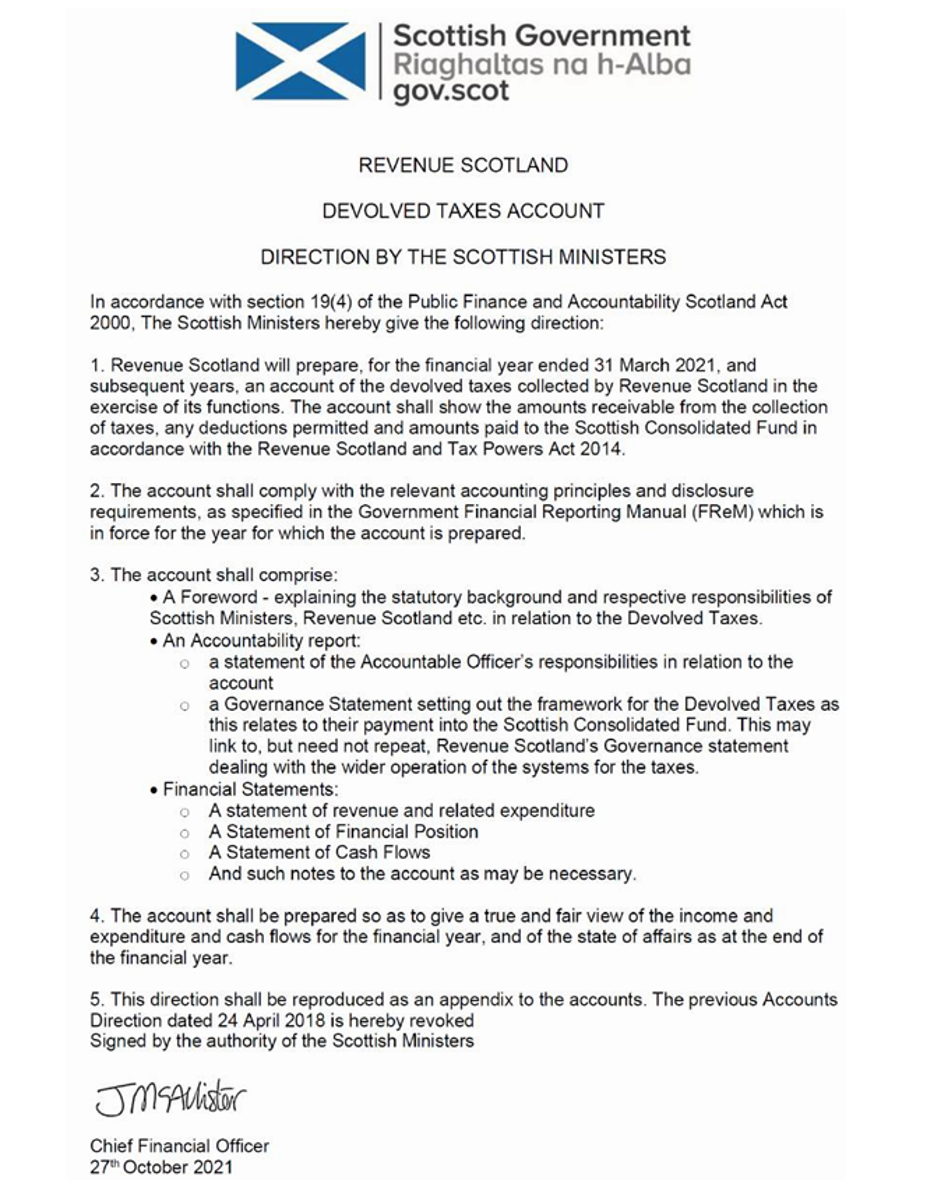
Revenue Scotland
Devolved Taxes Account
Direction by The Scottish Ministers
In accordance with section 19(4) of the Public Finance and Accountability Scotland Act 2000, The Scottish Ministers hereby give the following direction:
- Revenue Scotland will prepare, for the financial year ended 31 March 2021, and subsequent years, an account of the devolved taxes collected by Revenue Scotland in the exercise of its functions. The account shall show the amounts receivable from the collection of taxes, any deductions permitted and amounts paid to the Scottish Consolidated Fund in accordance with the Revenue Scotland and Tax Powers Act 2014.
- The account shall comply with the relevant accounting principles and disclosure requirements, as specified in the Government Financial Reporting Manual (FReM) which is in force for the year for which the account is prepared.
- The account shall comprise:
- A Foreword - explaining the statutory background and respective responsibilities of Scottish Ministers, Revenue Scotland etc. in relation to the Devolved Taxes.
- An Accountability report:
- a statement of the Accountable Officer's responsibilities in relation to the account
- a Governance statement setting out the framework for the Devolved Taxes as this relates to their payment into the Scottish Consolidated Fund. This may link to, but need not repeat, Revenue Scotland's Governance statement dealing with the wider operation of the systems for the taxes.
- Financial statements:
- A statement of revenue and related expenditure
- A statement of Financial Position
- A Statement of Cash Flows
- And such notes to the account as may be necessary.
- The account shall be prepared so as to give a true and fair view of the income and expenditure and cash flows for the financial year, and of the state of affairs as at the end of the financial year.
- This direction shall be reproduced as an appendix to the accounts. The previous Accounts Direction dated 24 April 2018 is hereby revoked.
Signed by the authority of the Scottish Ministers
J McAllister
Chief Financial Officer
27th October 2021