
Introduction
This section provides a detailed assessment of our performance in 2025–26. Our Corporate Plan 2024–27 focuses our activities on four Strategic Outcomes:
Our progress against each of our Strategic Outcomes is evaluated by success measures. The Strategic Outcomes and success measures are assessed in the subsequent sections. Our wider corporate performance is also examined in greater detail at the end of this section.
Operational Excellence
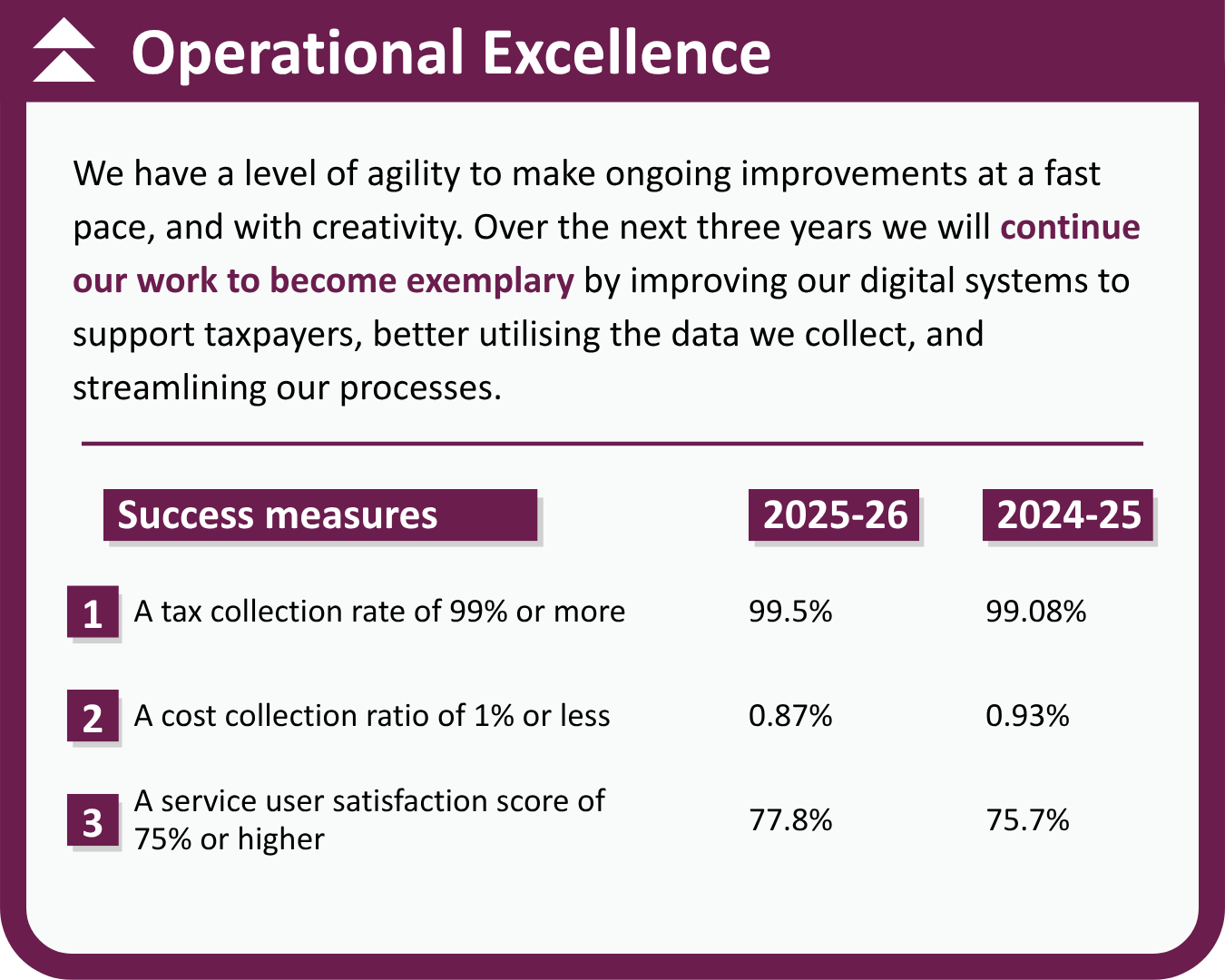
We have a level of agility to make ongoing improvements at a fast pace, and with creativity. Over the next three years we will continue our work to become exemplary by improving our digital systems to support taxpayers, better utilising the data we collect, and streamlining our processes.
| Success measures | 2025–26 | 2024–25 |
|---|---|---|
| 1. A tax collection rate of 99% or more | 99.5% | 99.08% |
| 2. A cost collection ratio of 1% or more | 0.87% | 0.93% |
| 3. A service user satisfaction score of 75% or higher | 77.8% | 75.7% |
We have achieved all three of the Success Measures in our Operational Excellence Strategic Outcome.
Through embracing innovation and new technologies, and putting users at the centre of our operations, we have adapted to our changing operating environment and the growth in our remit. Our corporate functions teams work closely with our tax teams daily to support the delivery of high-quality tax services, whilst maintaining a strong focus on efficiency and value for money.
To deliver Success Measures 1-3, we focused on four key areas:
1: Improving guidance available to taxpayers - Work with taxpayers to improve guidance, webinars, and systems design to enable taxpayers to comply with their obligations.
Ensuring our taxpayers are aware of their obligations is pivotal and below are some examples of initiatives and improvements we have made across the year.
SAT was introduced on 1 April 2026 and to ensure taxpayer readiness, we undertook a range of preparation activity to ensure that taxpayers understood their obligations and could comply from day one. This activity included:
- publishing clear guidance, including how to register and manage tax returns
- providing regular updates to keep taxpayers informed and supported in the transition from HMRC to us
- delivering webinars to explain the changes and answer questions.
In addition to timely guidance updates across all of our taxes, we have also concentrated efforts on engaging LBTT taxpayers and agents involved in non-residential leases to raise awareness of their obligations, in relation to reviewing the tax position of the lease every three years by submitting a lease review return. This was achieved through webinars, education leaflets, videos, social media, and working closely with local authorities and industry bodies.
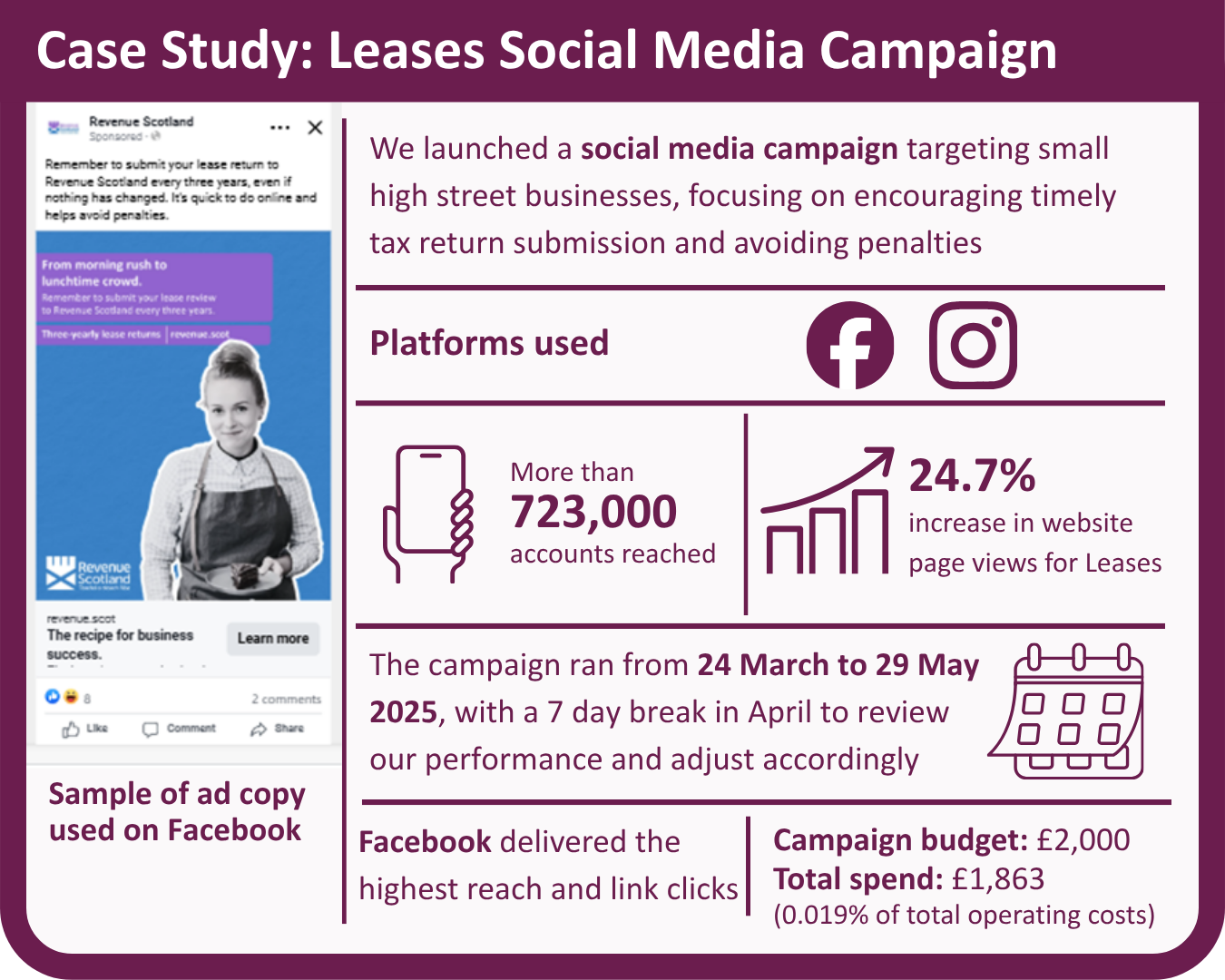
A graphic displays a sample of ad copy used on Facebook.
We launched a social media campaign targeting small high street businesses, focusing on encouraging timely tax return submission and avoiding penalties.
- Platforms used: Facebook, Instagram.
- More than 723,000 accounts reached.
- 24.7% increase in website page views for Leases.
The campaign ran from 24 March to 29 May 2025, with a 7 day break in April to review our performance and adjust accordingly.
Facebook delivered the highest reach and link clicks.
Campaign budget: £2,000
Total spend: £1,863 (0.019% of total operating costs)
2: Optimising our digital architecture - Create a single end-to-end digital tax service, which is modular by design to provide resilience and flexibility to make better use of data and administer additional taxes.
Throughout the year, we have continued to enhance the functionality of our digital systems, in addition to starting procurement for a replacement for SETS when the contract expires in 2029. The procurement window for our new digital platform provides a key opportunity to explore how we might take advantage of recent advancements in technology to achieve new efficiencies in how we administer our processes.
Enhancements to SETS
We delivered three updates to SETS within budget in the form of software drops, which included a total of 71 enhancements to the functionality of the platform. These included measures to enhance data quality and taxpayer compliance, improvements to user experience, cyber security, and delivery of requirements resulting from legislative change. We publish all key changes to SETS which directly affect external users on our website. One example of how we have made it easier for users to input correct data is by automatically populating data fields. We estimate that these user focused SETS platform enhancements will remove around 24,000 data errors per year.
Set off of tax
A legislative change to our processes delivered as part of the Aggregates Tax and Devolved Taxes Administration (Scotland) Act 2024 was to allow us to offset (“set off”) sums of money owed by a taxpayer against sums due to that taxpayer. This means a taxpayer doesn’t need to make a new payment for one return while waiting for a repayment from another.
Data platform
This year we developed our own cloud-based platform to store and analyse tax data, which replaces legacy software supplied by the Scottish Government that will shortly be discontinued. We identified this as one of our key risks under Risk 10 - Digital Performance and Adaptability, so it was vital to implement a new solution that ensured continuity of service for our Data team.
The platform will allow us to modernise our data analytics, and our reporting and visualisation capabilities, and enable us to derive more value from our data assets to further support Revenue Scotland operations.
The platform is managed as part of the Scottish Government’s infrastructure and has been designed using standard cloud approaches and platform agnostic code, supporting potential future migration, reducing the dependency on any single supplier.
3: Increasing use of automated processes and reporting - Improve our efficiency and effectiveness of our processes, enhance reporting capability and enable our staff to spend more time on fulfilling work.
Our commitment to increasing automation is demonstrated through the development of new functionality in SETS, which has included automating direct debit notifications sent to agents, improving payment reconciliation, automated debt processes, and developing a debt letter automation process for delivery in 2026–27.
In addition to embedding this new functionality, we have also been researching additional best practice for future consideration. This has included recently completing the OECD Tax Debt Management Maturity Model. This has been widely adopted by tax administrations as a tool to assess current practices, identify areas for improvement, and shape future strategies for managing tax debt.
The automations introduced in 2025–26 have led to a saving of 370 hours per year, or the equivalent of £9,100 of staff costs annually.
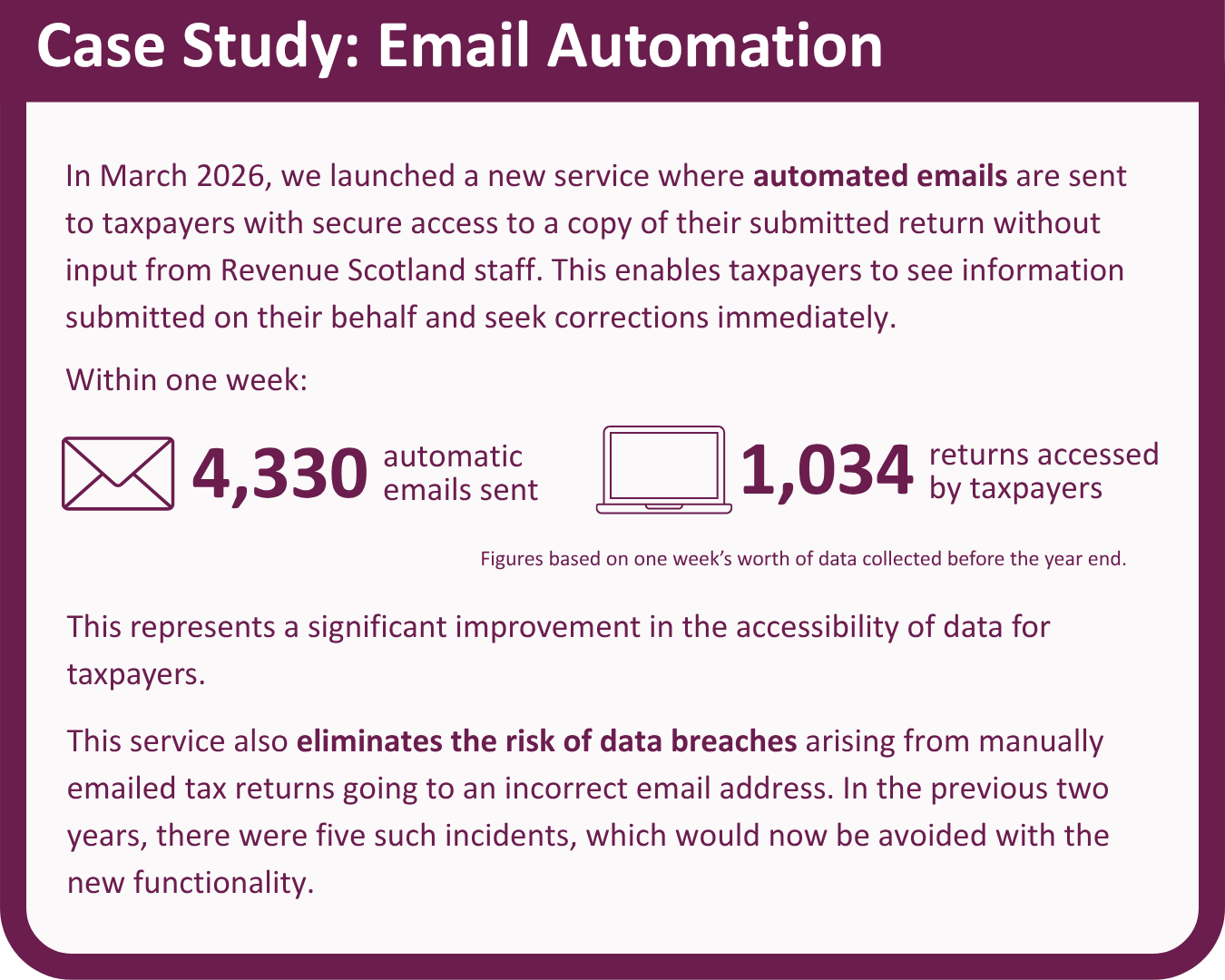
In March 2026, we launched a new service where automated emails are sent to taxpayers with secure access to a copy of their submitted return without input from Revenue Scotland staff. This enables taxpayers to see information submitted on their behalf and seek corrections immediately.
Within one week:
- 4,330 automatic emails sent
- 1,034 returns accessed by taxpayers
Figures based on one week's worth of data collected before the year end.
This represents a significant improvement in the accessibility of data for taxpayers.
This service also eliminates the risk of data breaches arising from manually emailed tax returns going to an incorrect email address. In the previous two years, there were five such incidents, which would now be avoided with the new functionality.
4: Designing user-centric systems - Collaborate with users of our systems to gather insights, ensuring they have an excellent experience as they engage with us and our systems.
Success Measure 3 requires us to design services that meet real user needs. To do so, we have strengthened our user-centred design (UCD) practice and our direct user engagement.
To ensure research is carried out ethically and consistently, we have:
- created standard templates, guidance and processes for UCD projects
- gathered user insight through multiple channels such as targeted research activity, and embedding feedback boxes into our digital services.
Feedback on our website guidance continues to provide an important source of evidence. More than 700 comments were submitted during the year, with over 78% of users rating the guidance as useful.
Other UCD activities this year include:
Pilot survey of authenticated SETS users
This identified different user types, perceptions of usability and priorities for improvement. It informed SETS roadmap priorities, including:
- easier address reuse across a return
- further improvements to our secure messaging service within SETS
- clearer guidance on user roles and permissions.
We will develop this into an annual survey to support ongoing performance measurement.
Embedding UCD across programmes
We integrated UCD into new taxes and service improvements, for example ADT, early engagement informed prototype design and requirements.
Operational Excellence Key Risks
If we fail to provide the necessary infrastructure, capacity and process to enhance the integrity of the tax system we will fail to deliver our core statutory purpose of protecting and collecting tax revenues.
Risk profile: High impact, low likelihood
We strive to minimise the scope for tax disputes to arise by proactively providing services to support taxpayers to pay the right amount of tax at the right time.
Key controls we have in place:
- Ensuring compliance with tax legislation through transparent compliance approaches
- Tax risk management frameworks in place
- Collaboration with other tax authorities and stakeholders
- Addressing and designing out tax risks through routine and targeted interventions
- Structured regime-specific compliance plans.
If we're not provided with adequate budget to meet our objectives, Revenue Scotland won't be able to target its investment to deliver the priorities within our corporate plan.
Risk profile: Medium impact, medium likelihood
We need to be prepared for any changes to our funding or investment priorities and manage our expenditure appropriately.
Key controls we have in place:
- Budget monitoring processes
- Scrutiny of performance and budget monitoring information by SLT
- Strict financial controls and escalation routes, controls over procurement and Programme Management Team oversight of delivery of major projects
- Long term financial plan giving an indication of future requirements
- Business cases needed for approval of all change programmes.
Failure to exploit the potential in our data, take opportunities to improve the design of our services, improve decision making, and identify areas for innovation could mean we don't create richer data that is of value to all parties.
Risk profile: Medium impact, medium likelihood
Key controls we have in place:
- The stats and MI team work closely with many teams across Revenue Scotland and external bodies such as the Welsh Revenue Authority (WRA) and Registers of Scotland (ROS). This is to understand the analytical needs of various teams and to improve the evidence they have for decision making
- Data Digital Strategy is now in place overseen by the Data Digital Programme Board
- Lease Review Projects Board have a workstream on using data more effectively to understand issues around lease reviews
- Additional external member has joined programme board to cover Data
- SG Data Cloud Platform in place.
Failure to maintain effective systems and controls would mean we're not able to securely collect and manage taxes whilst protecting taxpayer Information.
Risk profile: High impact, low likelihood
Cyber Security continues to be a critical area of focus as the threat landscape continues to evolve. Our Board are proactively involved in Cyber resilience, all board members completed the Cyber resilience code of practise training in 2025.
Key controls we have in place:
- Compliance with data protection legislation and requirements
- Use of Scottish Government IT Shared Services (SCOTS) and associated cyber protections
- Data Security and privacy policies and procedures to safeguard data against unauthorised breaches and leaks
- Contract management arrangements with key suppliers to review third party cyber-security controls including any supply chain dependencies
- Disaster recovery and Business Continuity arrangements to ensure data is backed up and can be quickly restored in the event of an incident.
Not having effective digital architecture and systems would affect our ambitions as outlined in the corporate plan.
Risk profile: High impact, low likelihood
Our Data and Digital Strategy helps us to meet our future Digital Data needs.
Key controls we have in place:
- Data and Digital Programme Board in place including independent members
- Data and Digital Strategy developed
- SG Data Cloud Platform in place
- Ivanti Workflow Management System
- Review of needs and requirements when contracts/systems are due for renewal.
If we don't plan, resource, procure and develop an effective replacement for SETS, we will be relying on an increasingly older system that isn't fit for purpose and may impact on our core tax functions and may fail to deliver our objectives.
Risk profile: High impact, low likelihood
Key controls we have in place:
- DDAT Project Board and Project Management arrangements in place
- Liaison with SG Procurement
- Legal support from Harper McLeod
- Management case and governance arrangements in place.
Any negative business continuity events or planning may lead to us being unable to collect and manage devolved taxes.
Risk profile: High impact, low likelihood
Key controls we have in place:
- Regular business continuity exercises (minimum of one per annum)
- Business Continuity Plans in place
- Participation in the SG Business Continuity Network
- Use of Objective Connect to allow access to key documents in the event of an incident
- Regular engagement with key suppliers to ensure cohesive business continuity strategies and preparedness.
Investing in our People
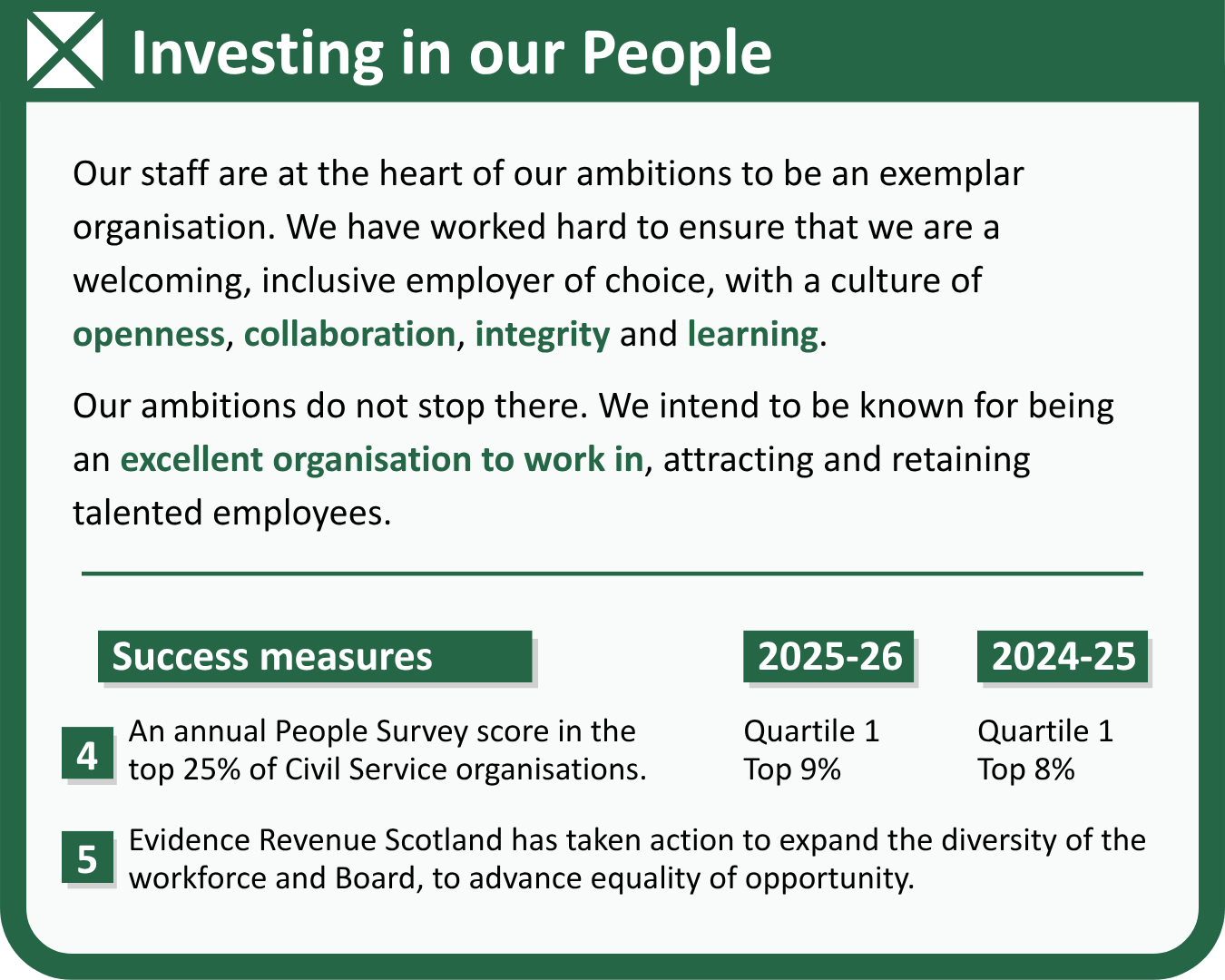
Our staff are at the heart of our ambitions to be an exemplar organisation. We have worked hard to ensure that we are a welcoming, inclusive employer of choice, with a culture of openness, collaboration, integrity and learning.
Our ambitions do not stop there. We intend to be known for being an excellent organisation to work in, attracting and retaining talented employees.
| Success measures | 2025–26 | 2024–25 |
|---|---|---|
| 4. An annual People Survey score in the top 25% of Civil Service organisations | Quartile 1 - Top 9% | Quartile 1 - Top 8% |
| 5. Evidence Revenue Scotland has taken action to expand the diversity of the workforce and Board, to advance equality of opportunity. | ||
We have achieved both Success Measures in our Investing in People Strategic Outcome.
Ensuring high levels of engagement with our staff has been a cornerstone of our organisation for the past 10 years. By investing in our people, we strengthen the foundation of our organisation and enable continued growth, resilience and innovation.
One of our key risks is organisational change. As new taxes and technologies are introduced, we must continue to adapt and evolve to meet changing demands. With our remit expanding from the collection and management of two devolved taxes to five, we must also drive efficiencies and maintain a forward-looking approach. To support these ambitions, we are undertaking an organisational restructure that will better position us to meet our future responsibilities and strengthen our capacity for long-term success. The new structure will be embedded in 2026-27 and reflected in next year’s Annual Report and Accounts.
To deliver Success Measures 4 and 5, we focused on four key areas:
1: Developing our capabilities - Ensuring all our staff have the right skills to succeed with a focus on leadership skills, deepening tax knowledge, and digital and data literacy.
Our People Strategy was created in partnership with our staff, and has been structured around four pillars:
- Leading and Managing Change
- Building Capability
- Talent Acquisition
- Resilience and Wellbeing
We have strengthened leadership and change management capability through improved communication, active feedback loops, quarterly leadership workshops and a dedicated line manager development programme. These efforts are reflected in our Civil Service People Survey (CSPS) results where we achieved:
- 82% for Leading and Managing Change (third highest across the Civil Service)
- 88% for the My Manager theme (second highest across the Civil Service). This is supported through delivery of our People Strategy Action Plan, which is reviewed annually by our Staffing and Equalities Committee
- 92% of staff report feeling trusted to carry out their roles effectively.
As illustrated in the graph below, our continued focus on and investment in our people has resulted in a significant increase in employee engagement.
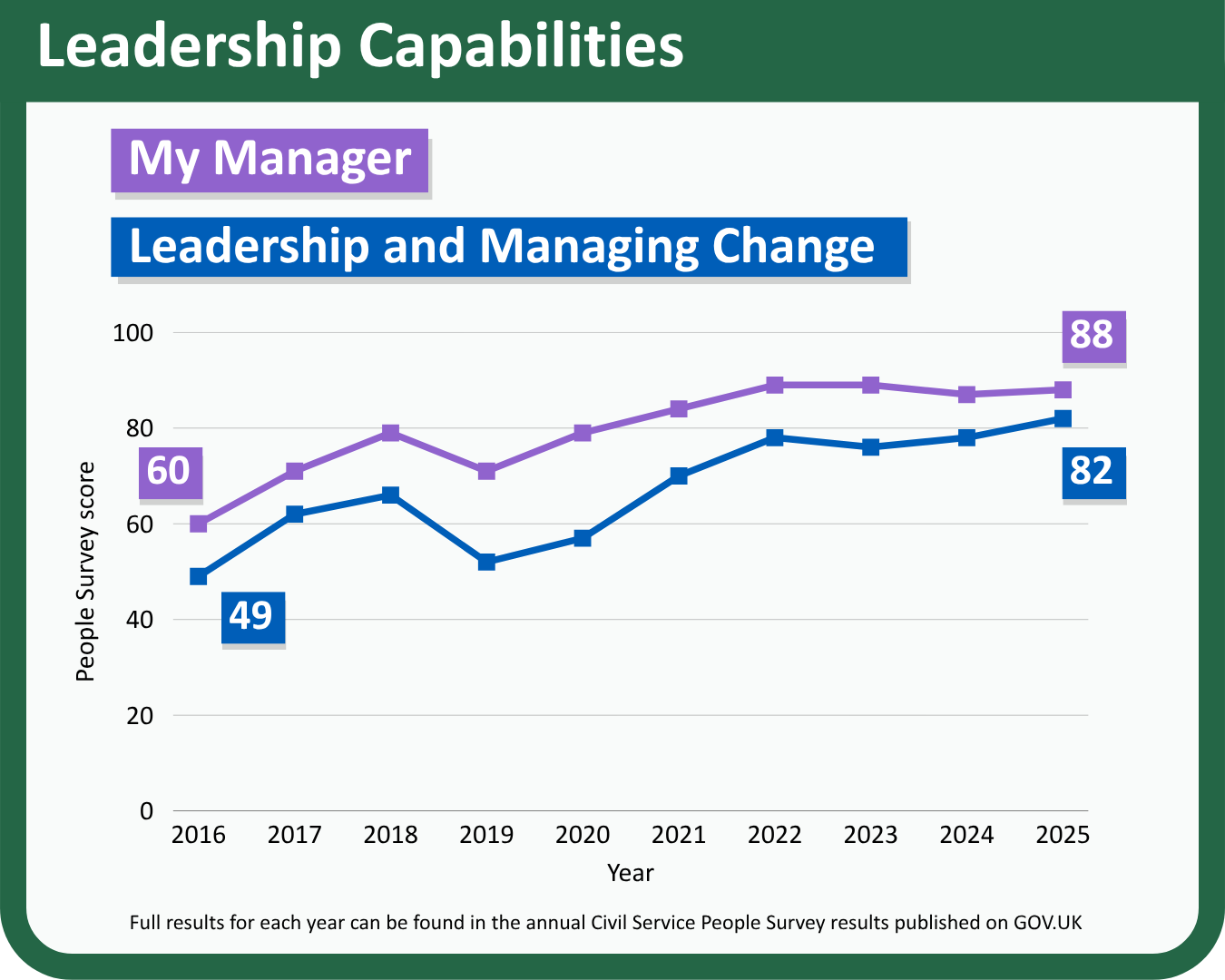
A line graph displaying two lines: My Manager and Leadership and Managing Change. The X-Axis shows the Year, from 2016 on the left to 2025 on the right. The Y-Axis shows the People Survey score, in increments of 20, from 0 at the bottom to 100 at the top.
The lines show a gradual increase in both scores, with both scores dropping in 2019.
Labels show the scores in 2016 (My Manager: 60; Leadership and Managing Change: 49) and in 2025 (My Manager: 88; Leadership and Managing Change: 82).
A footnote below the graph reads: Full results for each year can be found in the annual Civil Service People Survey results published on GOV.UK
The graph below recognises our performance across CSPS themes and highlights our excellent performance in comparison with Civil Service benchmark and Scottish Government.
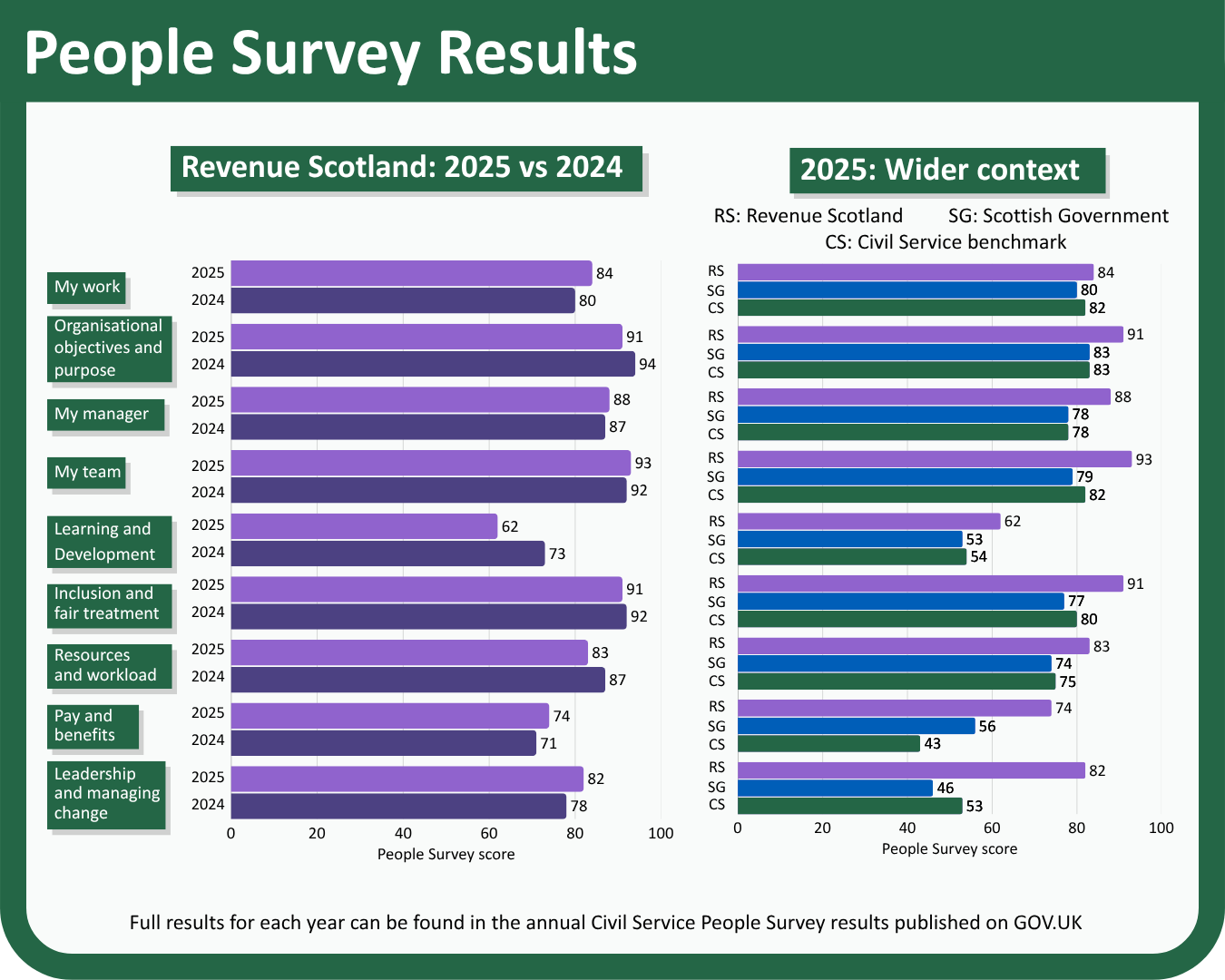
Two bar charts displaying results from the Civil Service People Survey.
The first chart, titled Revenue Scotland: 2025 vs 2024, compares Revenue Scotland's scores in the 2025 and 2024 surveys.
| Theme | 2025 | 2024 |
|---|---|---|
| My work | 84 | 80 |
| Organisational objectives and purpose | 91 | 94 |
| My manager | 88 | 87 |
| My team | 93 | 92 |
| Learning and development | 62 | 73 |
| Inclusion and fair treatment | 91 | 92 |
| Resources and workload | 83 | 87 |
| Pay and benefits | 74 | 71 |
| Leadership and managing change | 82 | 78 |
The second chart, titled 2025: Wider context, compares Revenue Scotland's scores with scores for the Scottish Government and the Civil Service benchmark scores.
| Theme | Revenue Scotland | Scottish Government | Civil Service benchmark |
|---|---|---|---|
| My work | 84 | 80 | 82 |
| Organisational objectives and purpose | 91 | 83 | 83 |
| My manager | 88 | 78 | 78 |
| My team | 93 | 79 | 82 |
| Learning and development | 62 | 53 | 54 |
| Inclusion and fair treatment | 91 | 77 | 80 |
| Resources and workload | 83 | 74 | 75 |
| Pay and benefits | 74 | 56 | 43 |
| Leadership and managing change | 82 | 46 | 53 |
A footnote below the graph reads: Full results for each year can be found in the annual Civil Service People Survey results published on GOV.UK
The annual Capability and Skills Audit plays a vital role in informing our workforce development priorities. Completed by 81 % of staff in partnership with their line managers, the audit assesses key skills and capabilities, helping to shape our strategic learning and development programme and ensuring we continue to build the skills needed both now and in the future. In 2025, the audit included an assessment of digital and data capabilities, which led to the introduction of a digital and data literacy module within the Scottish Tax Education Programme (STEP), with 89% of staff reporting that completing the STEP module helped increase their digital confidence. This initiative was designed to strengthen organisational capability in these critical areas, with progress to be evaluated through the 2026 Skills Audit.
To support the introduction of SAT in April 2026, we launched a STEP module in January to give all staff a foundation-level understanding, 98% of staff completed the SAT STEP module by 31 March, Operational and compliance teams with direct involvement in the new tax were also supported with further guidance and advanced learning.
We continue to achieve or exceed our KPIs, with 98% of staff completing at least 30 hours of learning and development. Through the proactive application of our people policies and a strong focus on succession planning, we have seen reductions in both staff turnover and absence levels.
The 2025 CSPS reported that 74% of staff feel they have access to suitable learning and development opportunities. Our learning and development opportunities are designed in response to the capability and skills audit outcomes.
Breakdown of learning and development activities across 2025–26
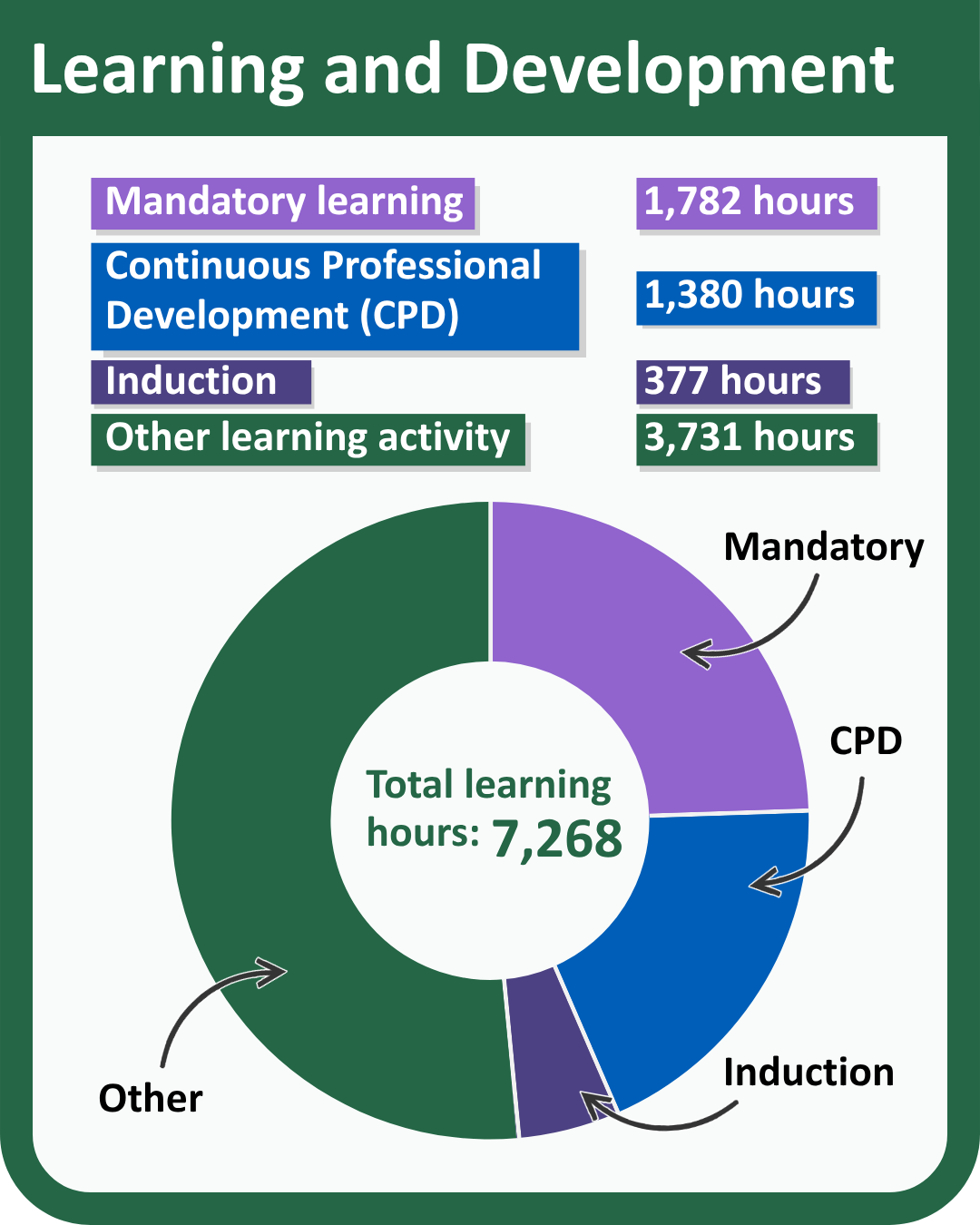
A doughnut chart displaying the breakdown in hours of various types of learning and development activity. Labels above the chart reads:
- Mandatory learning: 1,782 hours
- Continuous Professional Development (CPD): 1,380 hours
- Induction: 377 hours
- Other learning activity: 3,731 hours
Text in the centre of the chart reads: Total learning hours: 7,268
A professionally trained and engaged workforce drives improved compliance, stronger outcomes, increased tax revenue collection, and reduced employee turnover.
What our staff had to say
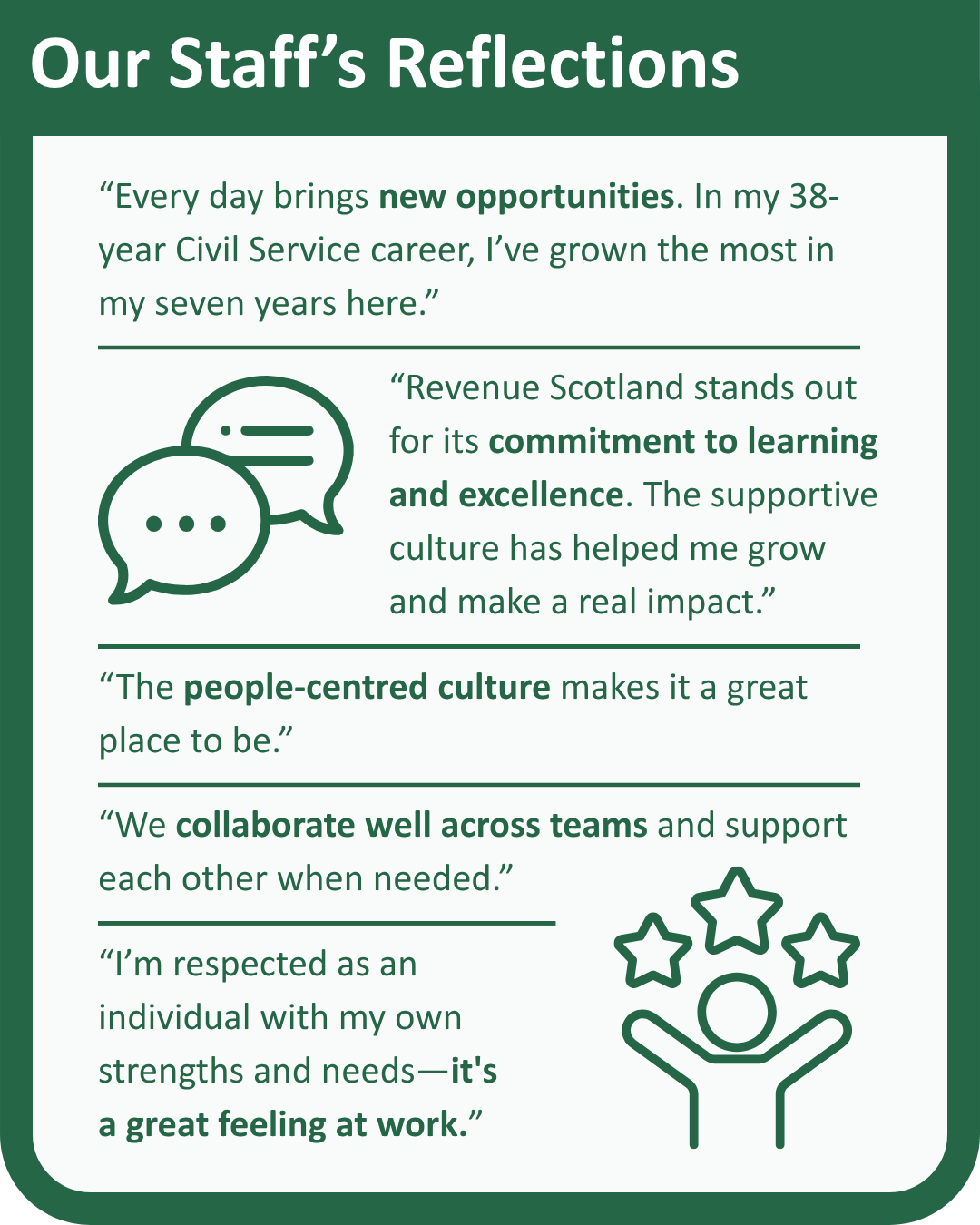
“Every day brings new opportunities. In my 38-year Civil Service career, I’ve grown the most in my seven years here.”
“Revenue Scotland stands out for its commitment to learning and excellence. The supportive culture has helped me grow and make a real impact.”
“The people-centred culture makes it a great place to be.”
“We collaborate well across teams and support each other when needed.”
“I’m respected as an individual with my own strengths and needs—it's a great feeling at work.”
2: Creating personalised career development plans for staff - Ensuring everyone can succeed in their role and supporting them in their career ambitions. Seeking opportunities for secondments, both outgoing and incoming.
Succession plans and development plans are essential to our practice and remain a key element of our succession approach. Our annual talent assessment informs our succession planning and is supported by personalised development plans to support career development aspirations.
Our approach has been enhanced this year to compliment the move to success profiles and allows for assessment across grade irrespective of role, this has informed strategic Learning and Development planning and personalised development plans for 26/27. Plans are reviewed with line managers during monthly conversations and at mid-year and end-of-year performance evaluations, with 72% of 77 respondents reporting having a personalised development plan in place.
Secondments are part of the 2026–27 People Strategy Action Plan and will be reported on next year.
3: Prioritising Equalities Diversity and Inclusion - Attracting diverse talent into our inclusive organisation, where everyone can bring their whole self to work.
We are committed to Equality, Diversity and Inclusion, and aim for a workforce that reflects the society we serve. Our progress is demonstrated through the diversity data published in our Equalities Mainstreaming report and progress report 2024 - 2026.
As part of improving our inclusive recruitment approach, we took part in the Scottish Government’s Economic Inactivity Programme Pilot with Business in the Community, which helped us strengthen our recruitment and progression practices. We review our recruitment diversity data every six months and ensure all hiring managers complete Inclusive Recruitment Practice training before leading campaigns. In line with the Fairer Scotland Duty, we also support Fair Start Scotland and continue building partnerships with Inclusion Scotland.
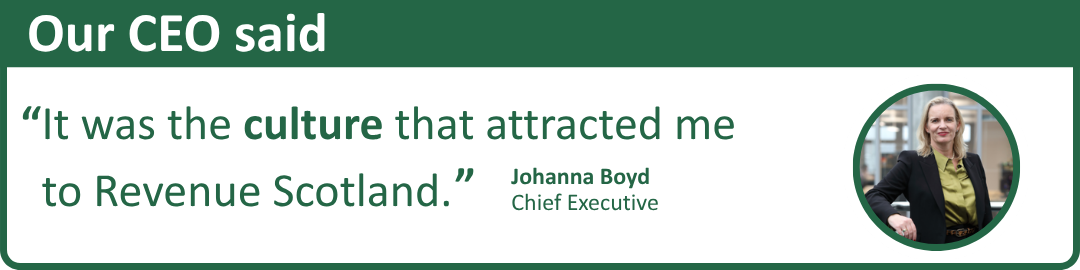
"It was the culture that attracted me to Revenue Scotland." - Johanna Boyd, Chief Executive
97% of our staff agreed in the CSPS that we are committed to fostering a diverse and inclusive workplace. Health, Wellbeing and Inclusion campaigns further celebrate our culture through lived experience. National Inclusion Week explored diversity in race, religion and socio-economic background. Neurodiversity Week and Purple Day increased awareness and understanding of neurodiversity and epilepsy.
We are committed to promoting diversity across our Board and its Committees, ensuring that they reflect the communities we serve. Working closely with the Scottish Government and other partners, we actively promote Board and committee vacancies and deliver information sessions through a range of networks to encourage applications from under-represented groups. As a result of these recruitment and engagement activities, three co-opted members have joined our Board Committees, bringing greater diversity of experience and perspectives. In addition, two new full Board members have been appointed, further strengthening the diversity and representation of our governance arrangements.
4: Empowering our Staff - Giving our staff autonomy, the tools for a healthy work-life balance, being transparent, and showing recognition.
Our Hybrid Operating Model is designed to maximise engagement, collaboration, and team connectivity through a combination of purposeful office-based activity and flexible home working. Underpinned by our Hybrid Working principles and Hybrid Ways of Working Charter, the model supports staff wellbeing, operational delivery, and excellent customer service. The office plays a distinct role in facilitating collaboration, learning and development, onboarding and relationship building, while technology enables inclusive participation and connectivity regardless of location.
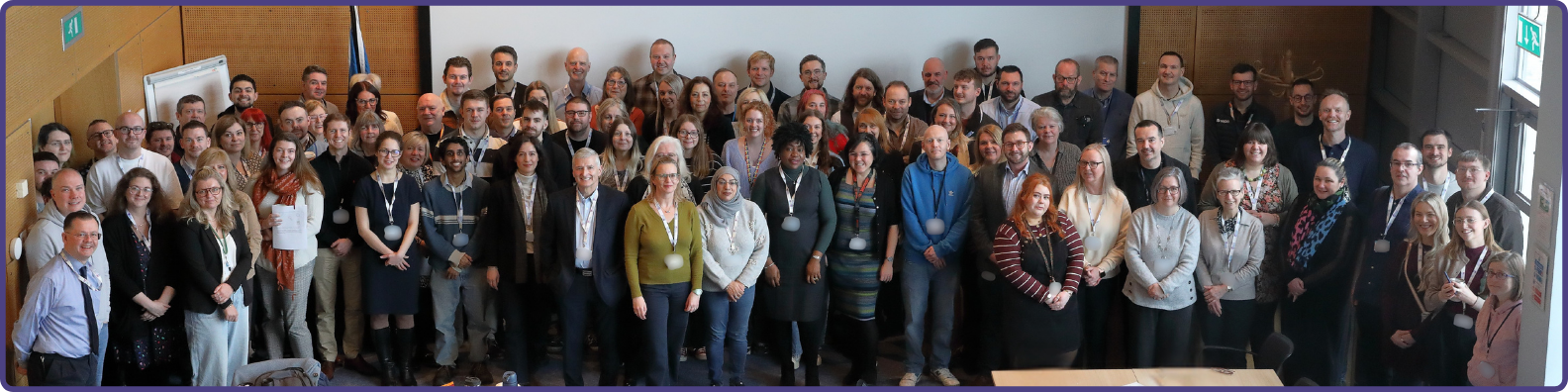
We bring all staff together, in person, twice a year through staff conferences to reinforce organisational culture, share strategic priorities and celebrate success. This approach is complemented by weekly all-staff calls that provide updates on performance, priorities and stakeholder engagement. Managers play an important role in supporting hybrid teams, fostering regular communication, maintaining team cohesion, and ensuring colleagues have equitable access to development opportunities, support, and resources regardless of where they work.
Our people-centred culture is a key strength. In the CSPS, 83% of respondents said they would recommend Revenue Scotland as a great place to work, 85% reported having choice in how they do their work, and 89% said their manager recognises good performance. Alongside our commitment to hybrid working, learning and development, this supports employee attraction, retention and progression.
Resilience and Wellbeing is one of the four pillars of our People Strategy, ensuring staff have the capability and capacity to deliver our expanding responsibilities. This year, our wellbeing campaigns and staff conferences have focused particularly on supporting health and wellbeing.
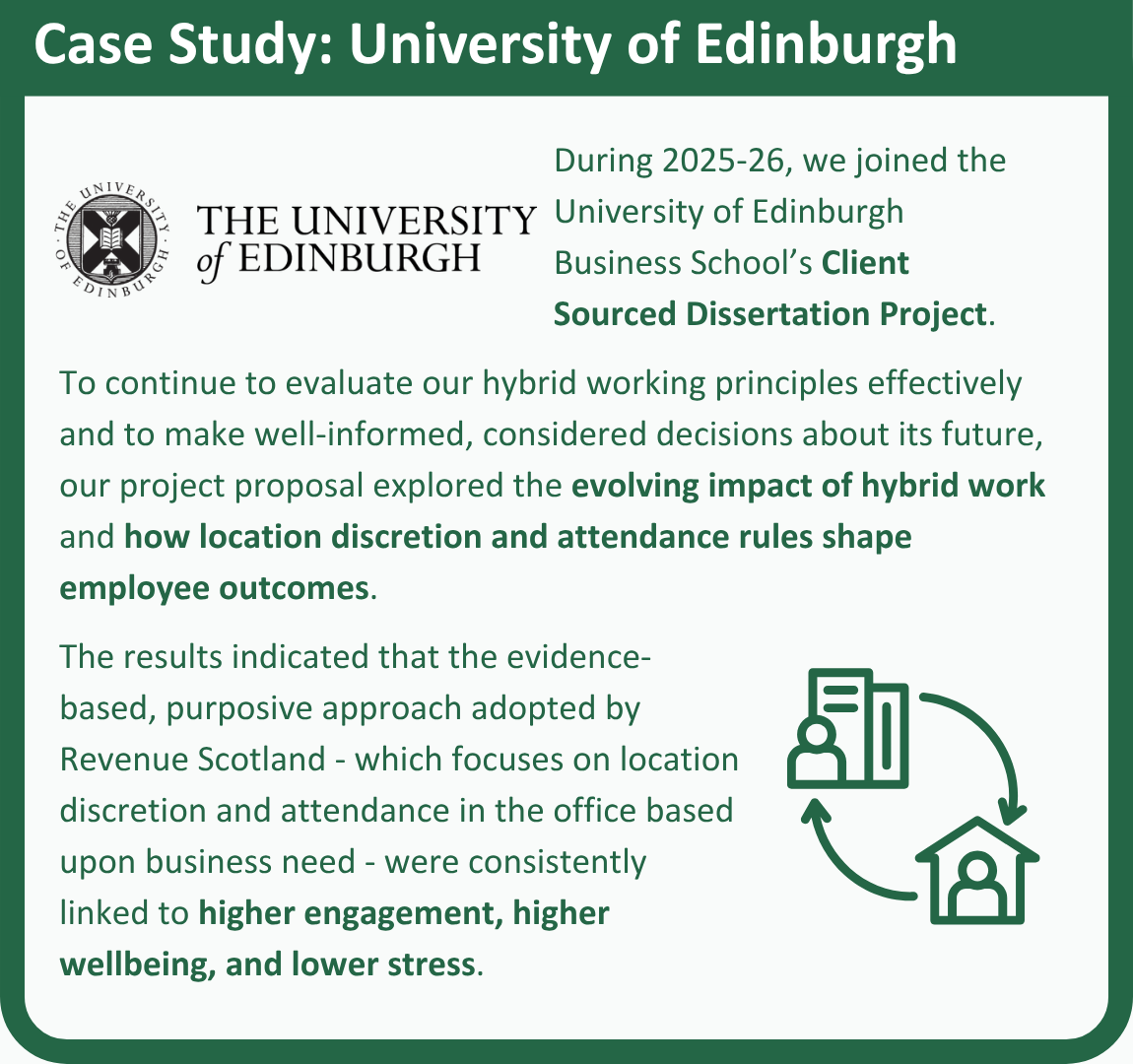
During 2025–26, we joined the University of Edinburgh Business School’s Client Sourced Dissertation Project.
To continue to evaluate our hybrid working principles effectively and to make well-informed, considered decisions about its future, our project proposal explored the evolving impact of hybrid work: how location discretion and the 60% attendance rules shape employee outcomes.
The results indicated that the evidence-based, purposive approach adopted by Revenue Scotland - which focuses on location discretion, office purpose and attendance in the office based upon business need - were consistently linked to higher engagement, higher wellbeing, and lower stress.
Investing in our People Key Risks
If our people maybe subject to accident or injury, their mental health and wellbeing may also suffer and we may not be in a position to deliver our business priorities.
Risk profile: High impact, low likelihood
Key controls we have in place:
- Compliance with Health and Safety regulations
- External 'Competent Person' in place and arrangements with SEPA re landfill site visits
- Regular risk assessments to identify potential hazards and implementing appropriate measures to mitigate these risks; Incident reporting and investigation processes in place
- Ongoing employee training and awareness raising activities
- Early intervention through stress risk assessments and proactive use of Occupational Health and Employee Assistance Programme.
Failure to adequately resource the organisation and support staff to deliver our programme of change will affect our resilience and operational performance will be compromised.
Risk profile: Very high impact, medium likelihood
Building robust capability to adapt to future changes is essential to ensure we maintain all of our operations.
Key controls in place
- Strategic workforce planning and succession planning reviewed quarterly
- Coaching and Development in place; Strategic L&D interventions informed by the gaps identified in the capability and skills audit
- Staff engagement through weekly all staff, weekly leadership stand ups and bi annual staff conferences; Monitoring of Hybrid working principles on a quarterly basis
- Civil Service People Survey issued annually
- DDAT Project board and Project Management arrangements in place.
Working with Others
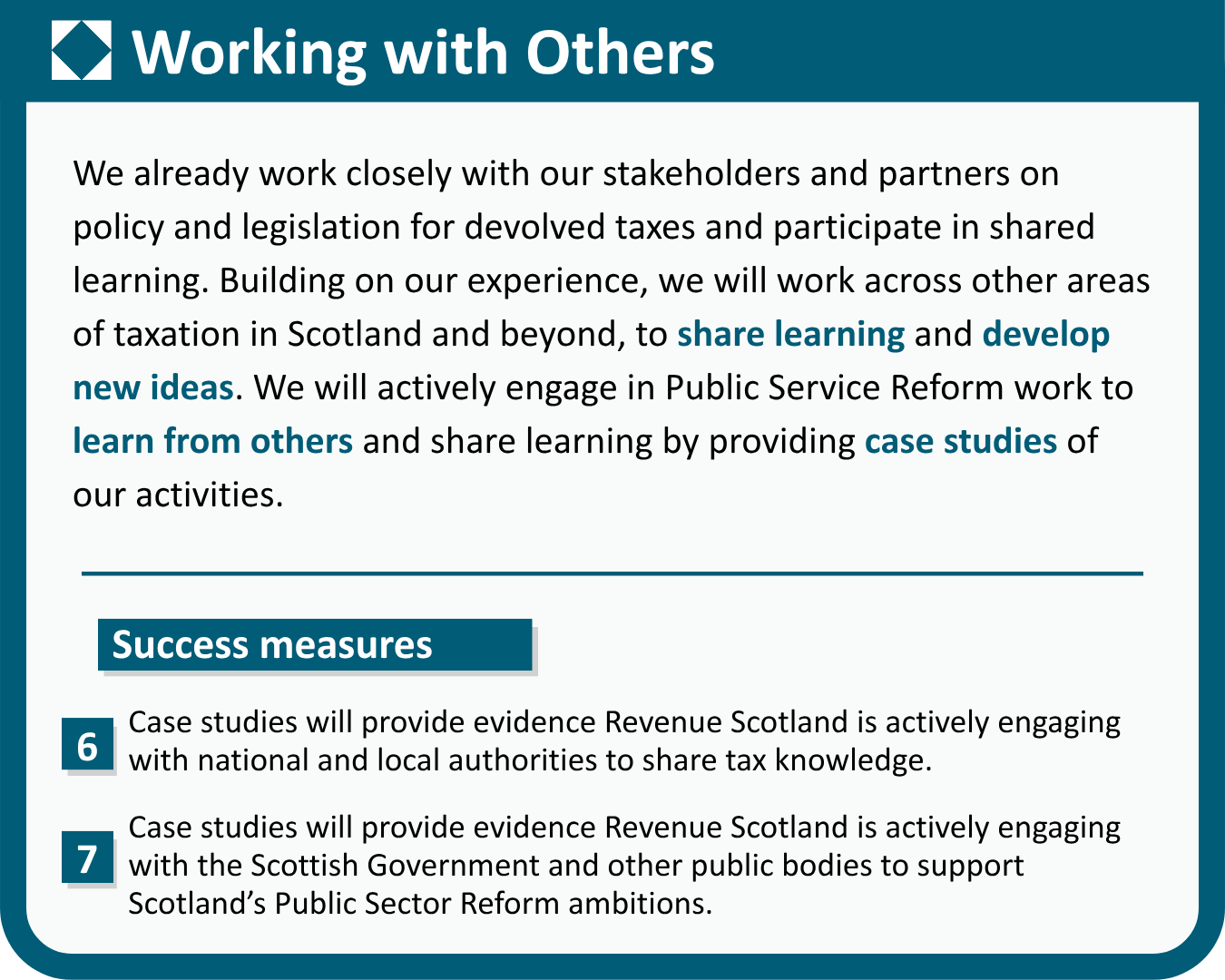
We already work closely with our stakeholders and partners on policy and legislation for devolved taxes and participate in shared learning. Building on our experience, we will work across other areas of taxation in Scotland and beyond, to share learning and develop new ideas. We will actively engage in Public Service Reform work to learn from others and share learning by providing case studies of our activities.
| Success measures |
|---|
| 6. Case studies will provide evidence Revenue Scotland is actively engaging with national and local authorities to share tax knowledge. |
| 7. Case studies will provide evidence Revenue Scotland is actively engaging with the Scottish Government and other public bodies to support Scotland’s Public Sector Reform ambitions. |
We have achieved both Success Measures in our Working with Others Strategic Outcome. Case studies in this section highlight the expertise that we offer in working collaboratively to deliver value for the people of Scotland.
To deliver Success Measures 6 and 7, we focused on four key areas:
1. Sharing learning on devolved taxation - Through building our partnerships and networks we will continue to collaborate and work together on shared goals.
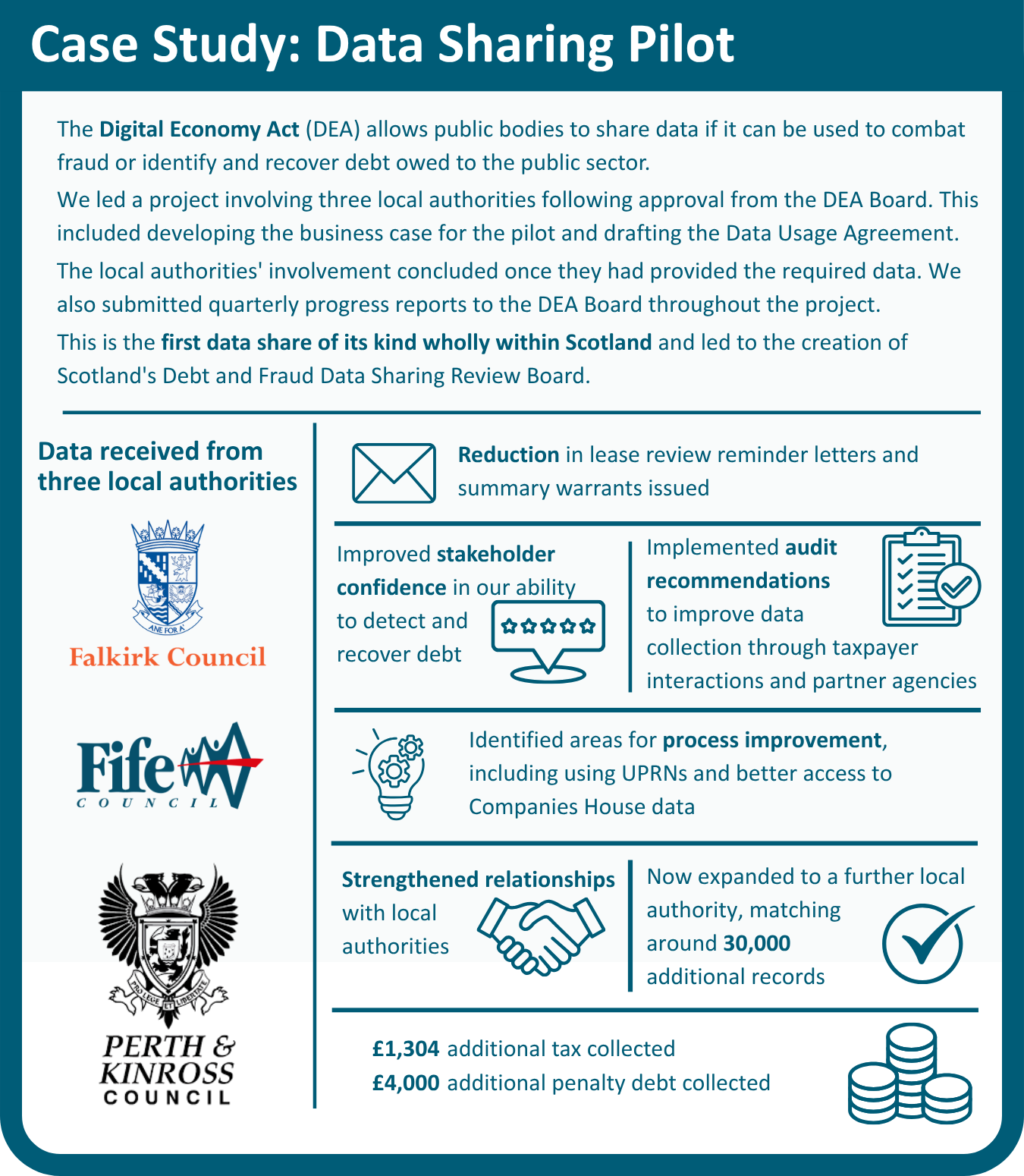
The Digital Economy Act (DEA) allows public bodies to share data if it can be used to combat fraud or identify and recover debt owed to the public sector.
We led a project involving three local authorities following approval from the DEA Board. This included developing the business case for the pilot and drafting the Data Usage Agreement.
The local authorities' involvement concluded once they had provided the required data. We also submitted quarterly progress reports to the DEA Board throughout the project.
This is the first data share of its kind wholly within Scotland and led to the creation of Scotland's Debt and Fraud Data Sharing Review Board.
Data received from three local authorities:
- Falkirk Council
- Fife Council
- Perth & Kinross Council
- Reduction in lease review reminder letters and summary warrants issued
- Improved stakeholder confidence in our ability to detect and recover debt
- Identified areas for process improvement, including using UPRNs and better access to Companies House data
- Strengthened relationship with local authorities
- Now expanded to a further local authority, matching around 30,000 additional records
£1,034 additional tax collected; £4,000 additional penalty debt collected
The Environmental Tax Team works closely with a wide range of stakeholders, including SEPA, Scottish Government policy teams, HMRC, HM Treasury, WRA, the Joint Unit for Waste Crime, and industry representatives.
Through our partnership with SEPA and Scottish Government colleagues, we provide insight on industry trends, assess the tax impacts of policy decisions, and help identify emerging risks. A key focus has been supporting the implementation of the Biodegradable Municipal Waste ban and assessing its effects on the waste sector.
Working with SEPA and Scottish Government, it was identified that the Scottish Landfill Communities Fund could become financially unsustainable as landfill volumes reduced in line with the Landfill Tax policy objective. Following consultation and analysis, Ministers decided to close the fund to new contributions from 1 April 2026, removing the risk of future costs to the public purse. We, as the body with overall responsibility for the fund, will continue to work alongside SEPA, the designated regulator of the fund, to ensure the orderly winding up of the scheme over the next two years prior to its permanent closure.
We also collaborate with HMRC, WRA and industry representatives to share intelligence, address emerging tax risks, and support the introduction of Scottish Aggregates Tax. Early engagement led to more than 100 operators registering before the tax commenced.
As a strategic partner of the Joint Unit for Waste Crime, we contribute to UK-wide efforts to tackle waste crime, using tax intelligence and compliance activity to strengthen environmental and fiscal outcomes.
2. Playing a 'sector connector’ role - We will establish new connections, bringing people together, offering new opportunities for collaborative working in tax across the UK and beyond.
This allows us to deepen our relationships and learning from all our stakeholders and actively engage in PSR as a 'sector connector' across the Scottish Administration.
Ten years of Revenue Scotland: Outcomes, impact and lasting benefits
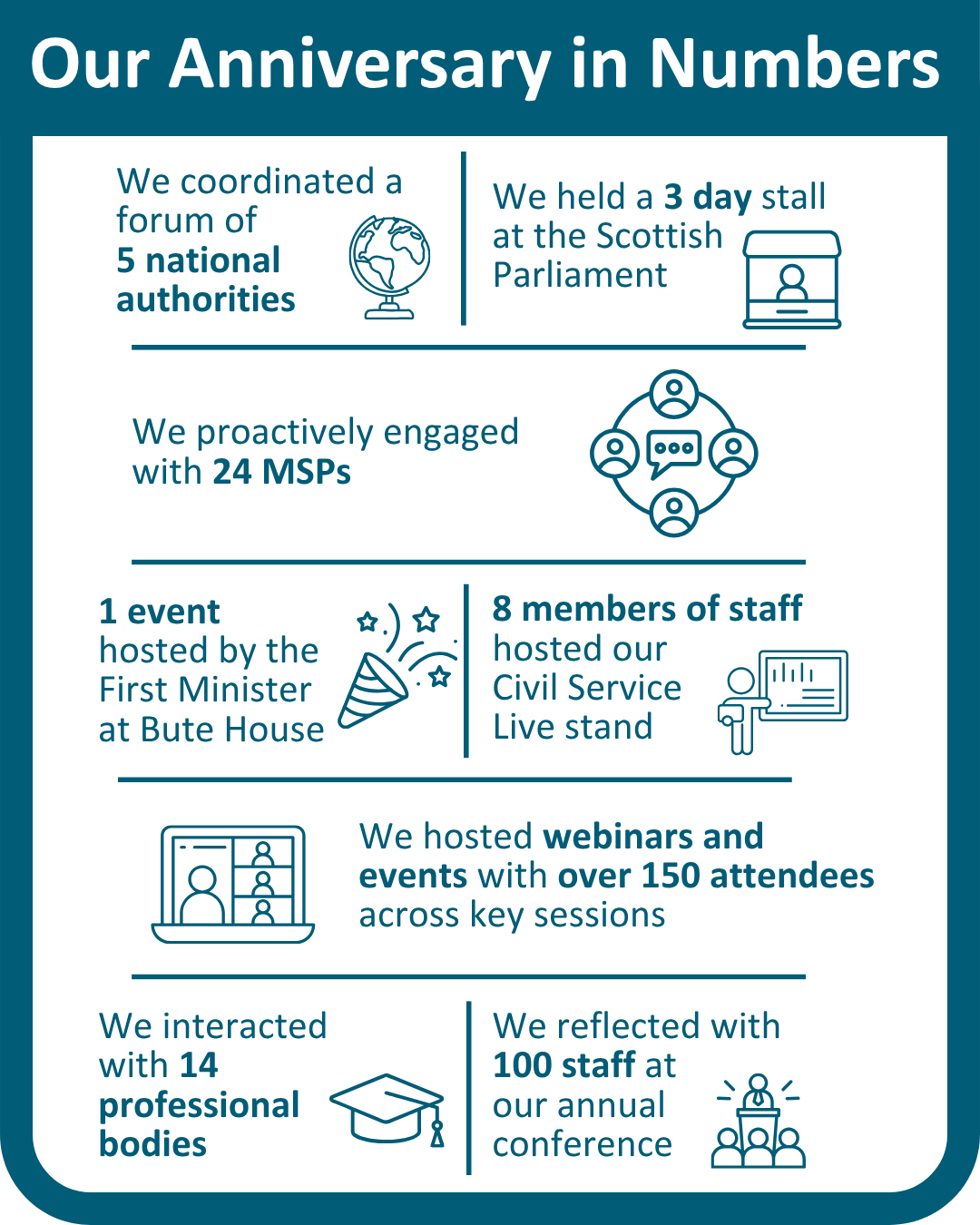
- We coordinated a forum of 5 national authorities
- We held a 3 day stall at the Scottish Parliament
- We proactively engaged with 24 MSPs
- 1 event hosted by the First Minister at Bute House
- 8 members of staff hosted our Civil Service Live stand
- We hosted webinars and events with over 150 attendees across key sessions
- We interacted with 14 professional bodies
- We reflected with 100 staff at our annual conference
We marked our tenth anniversary in 2025–26 with a programme of events that strengthened partnerships, enhanced organisational capability, increased engagement, and reinforced its reputation as a modern tax authority.
The programme deepened relationships with tax authorities across the UK and internationally, including HMRC, WRA and the Canada Revenue Agency, while creating new partnerships with organisations such as Public Digital, Business in the Community, the University of Strathclyde and the Centre for Public Policy. These collaborations expanded opportunities to share expertise and support service improvement.
Engagement with MSPs, parliamentary committees and national conferences increased awareness of our role and contribution to Scotland’s fiscal landscape, supporting more informed dialogue on tax policy and administration.
A series of webinars and events explored key themes including data quality, digital transformation, organisational performance and ten years of devolved taxes. The insights gained will inform future strategy, strengthen organisational capability, and support continuous improvement.
The programme also contributed to wider discussions on Scotland’s tax system, including devolved tax powers, tax reform, and fiscal literacy. Internally, anniversary events strengthened staff engagement and organisational culture.
Through a coordinated communications campaign, we increased visibility and public understanding of our work. The relationships, learning and insights developed during the anniversary year will continue to support effective tax administration and organisational development into its second decade.
Our relationship with the Centre for Public Policy (CPP) began in 2024.
CPP were instrumental in organising an event which brought a number of specialists together to discuss the devolution journey in Scotland and the potential future of taxation. The event was hosted in their state-of-the-art facilities at the University of Glasgow.
We now work closely with CPP on other matters, including including attending events and creating a fiscal literacy product and learning for incoming elected members.
3. Leading the way in Public Service Reform (PSR) - We will embrace change, supporting others by sharing our learning and showcasing our digital services and shared service model.
As mentioned in the previous section, we are developing two proposals which align with the ambitions and objectives of the PSR strategy, the first of which is a tax platform in the form of a single online portal that would allow taxpayers to engage with a range of Scottish tax and other services. This will be considered further in 2026-27.
The second proposal is to develop a single system for the billing and collection of non-domestic rates (NDR), drawing upon the work of the Barclay Review in 2017.
Currently, there are 32 local councils that operate and administer NDR across Scotland. While the Scottish Government sets the non-domestic rates, each of the 32 councils is responsible for billing, collecting and applying local reliefs in their area. By moving to a single system for the collection and billing of non-domestic rates, opportunities could arise for:
- enhanced compliance, resulting in higher revenues to support public services
- improved data quality
- enhanced and consistent ratepayer experience
- policy changes implemented quicker and reduced costs for system changes
- better able to spot any fraudulent activity and non-compliance.
Non-domestic rates revenues are around £3bn for 2025–26.
See table on page 63 for forecasts: Scotland's Economic and Fiscal Forecasts January 2026
Substantiated by:
A working group, led by the Improvement Service and involving a range of public bodies including Scottish Government, COSLA and Revenue Scotland has been established to consider the proposal for a single online platform for NDR further. We will continue to engage and advise on this proposal as it progresses.
Working with Others Key Risks
If we don't raise our profile across all of our audiences we will miss opportunities to have influence in support of our Corporate Plan Objectives.
Risk profile: Medium impact, medium likelihood
Our Communications and Engagement Plan is designed to enhance our visibility and assert our presence.
Key controls we have in place:
- Engagement delivery plan in place. This works in tandem with our Communications Strategy to further support our engagement activities
- Developing tax policy capability with RS
- Outreach activities and regular use of external stakeholder communications to push our messaging; Participation and attendance at key stakeholder events by Board members, SLT and Tax team leaders, with a proactive approach to seeking out opportunities
- Professional development of engagement staff
- Proactive engagement in work around Public Service Reform (PSR).
Expanding Horizons
We will work in partnership with the Scottish Government to develop new devolved taxes — Scottish Aggregates Tax (SAT), Air Departure Tax (ADT) and the proposed Scottish Building Safety Levy (SBSL) — and on proposals to review and amend the legislation for the existing devolved taxes in the light of operational experience.
Aligning with existing partnership principles, we will bring people together and offer support on policy and legislation in other areas of taxation in Scotland, including local taxes.
| Success measures |
|---|
| 8. Evidence Revenue Scotland has actively worked in partnership with the Scottish Government to develop and deliver new devolved taxes will be reported each year in the Annual Report and Accounts. |
| 9. Evidence Revenue Scotland has contributed knowledge and supported the developments of new and existing local taxes will be reported each year in the Annual Report and Accounts. |
We have achieved both Success Measures in this Outcome, by demonstrating the expertise that we offer in working collaboratively to deliver value for the people of Scotland.
To deliver Success Measures 8 and 9, we focused on four key areas:
1a. Working in partnership with Scottish Government. Developing and delivering new devolved taxes. We will support the development of SAT and the proposed SBSL. Our delivery programmes will ensure readiness for their introduction.
Throughout 2025–26 we have continued to strengthen our role in developing and delivering Scotland’s expanding suite of devolved taxes. At the Scottish Budget 2026–27, the Cabinet Secretary for Finance announced that ADT will become operational in Scotland on 1 April 2027, replacing the equivalent UK tax, Air Passenger Duty. Our New Devolved Taxes Programme, originally established to introduce SAT and SBSL, has therefore now been extended to include preparations for ADT. Current estimates of revenue to be collected from the new taxes are in the region of £30m per annum for SBSL and £350m per annum for ADT.
Scottish Aggregates Tax
Working closely with representatives of the aggregates industry and others, we successfully introduced Scottish Aggregates Tax on 1 April 2026. Details of this work are set out in the case study below.
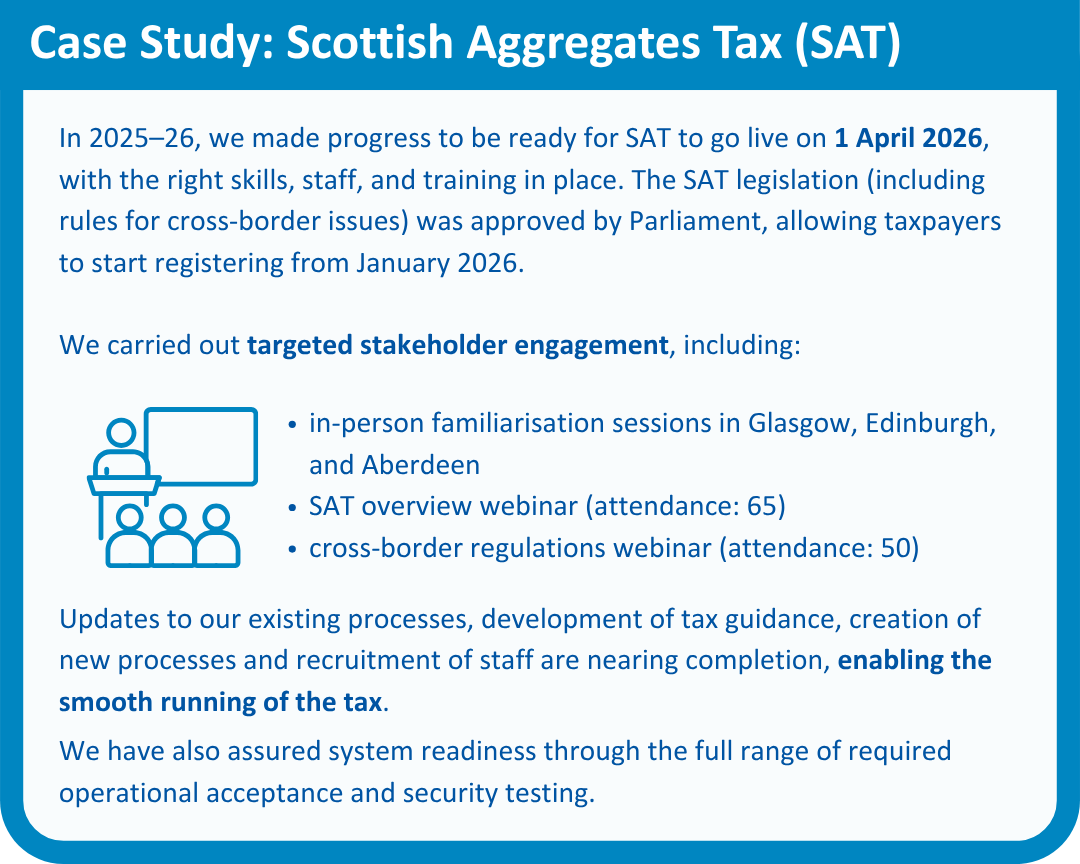
In 2025–26, we made progress to be ready for SAT to go live on 1 April 2026, with the right skills, staff, and training in place. The SAT legislation (including rules for cross-border issues) was approved by Parliament, allowing taxpayers to start registering from January 2026.
We carried out targeted stakeholder engagement, including:
- in-person familiarisation sessions in Glasgow, Edinburgh, and Aberdeen
- SAT overview webinar (attendance: 65)
- cross-border regulations webinar (attendance: 50)
Updates to our existing processes, development of tax guidance, creation of new processes and recruitment of staff are nearing completion, enabling the smooth running of the tax.
We have also assured system readiness through the full range of required operational acceptance and security testing.
Scottish Building Safety Levy
We have continued to support the development of SBSL, following introduction of the Bill in June 2025 and the confirmation of a revised go-live date of 1 April 2028. Work has progressed on tax design, key policy areas, financial modelling, and development of relevant documentation. Engagement with the Scottish Government led Expert Advisory Group, which draws its membership from across a range of stakeholder organisations, is on-going.
Air Departure Tax
We have commenced preparatory work for ADT, with joint planning sessions between us, Scottish Government Policy colleagues and HMRC. As with SAT we are working closely with the Scottish Government team in the design of a practical tax. Building on our experience gained through delivery of SAT, we have engaged extensively with industry representatives at an early stage. This has enabled us to gain a valuable insight into their operational processes and ways of working. This work is continuing with stakeholder input crucial to design and implementation of the tax.
1b. Reviewing devolved taxes legislation - We will work with Scottish Government to review legislation for existing taxes in light of operational experience.
Over the past year, our legislative framework programme team has supported the Scottish Government’s Review of LBTT and identified potential legislative improvements across our existing taxes, future taxes and wider tax framework. The programme aims to improve legislation, deliver better outcomes for taxpayers and strengthen our core functions. We have also monitored developments across other tax authorities, including HMRC’s Tax Administration Framework Review and Transformation Roadmap, and the WRA’s consultation on changes to the Welsh Tax Acts.
The LBTT Review, an action under Scotland’s Tax Strategy, is assessing whether key elements of the Land and Buildings Transaction Tax (Scotland) Act 2013 are operating as intended, including the three yearly lease review return arrangements.
The Scottish Government has also announced research into whether Scottish Landfill Tax continues to support circular economy and environmental objectives. We will contribute to the steering group, providing expertise to help inform the future of the tax.
This work continues to be delivered collaboratively by us and the Scottish Government reflecting the strong partnership set out in our Framework Document.
2. Supporting development of local taxes - We will offer our insights on digital services and tax collection and compliance; we will support the development of tax policy and legislation.
Alongside developing and implementing new taxes and reviewing devolved tax legislation, we have played a key role in shaping the development of local taxes and other revenue-raising measures in Scotland. By bringing operational, digital and tax administration expertise into policy discussions at an early stage, we have helped ensure that delivery considerations are embedded in policy design from the outset. In particular, we have supported the development of Visitor Levy in Scotland; see the case study below for more information.
We also support wider policy thinking on other taxes in Scotland. For example, we have contributed to discussions on the development of a single-use cup charge, carbon land taxes, non-domestic rates reform and council tax reform. Our expertise has provided a practical and credible perspective on how tax policy can be implemented effectively for better societal and environmental outcomes.
Sustainability remains a central focus of our work. Scottish Landfill Tax and Scottish Aggregates Tax are important policy levers supporting Scotland’s circular economy and environmental objectives. These taxes drive sustainable use of resources by reducing landfill disposal and promoting the use of recycled aggregates.
This work has fostered stronger partnerships across the Scottish Government, local government, and industry, helping to drive public service reform through collaborative working and the sharing of expertise. As a result, it has made a positive contribution towards achieving our Strategic Outcome of Working with Others.
We will continue to provide trusted leadership and specialist tax expertise to support the development and delivery of Scotland’s future revenue-raising measures.
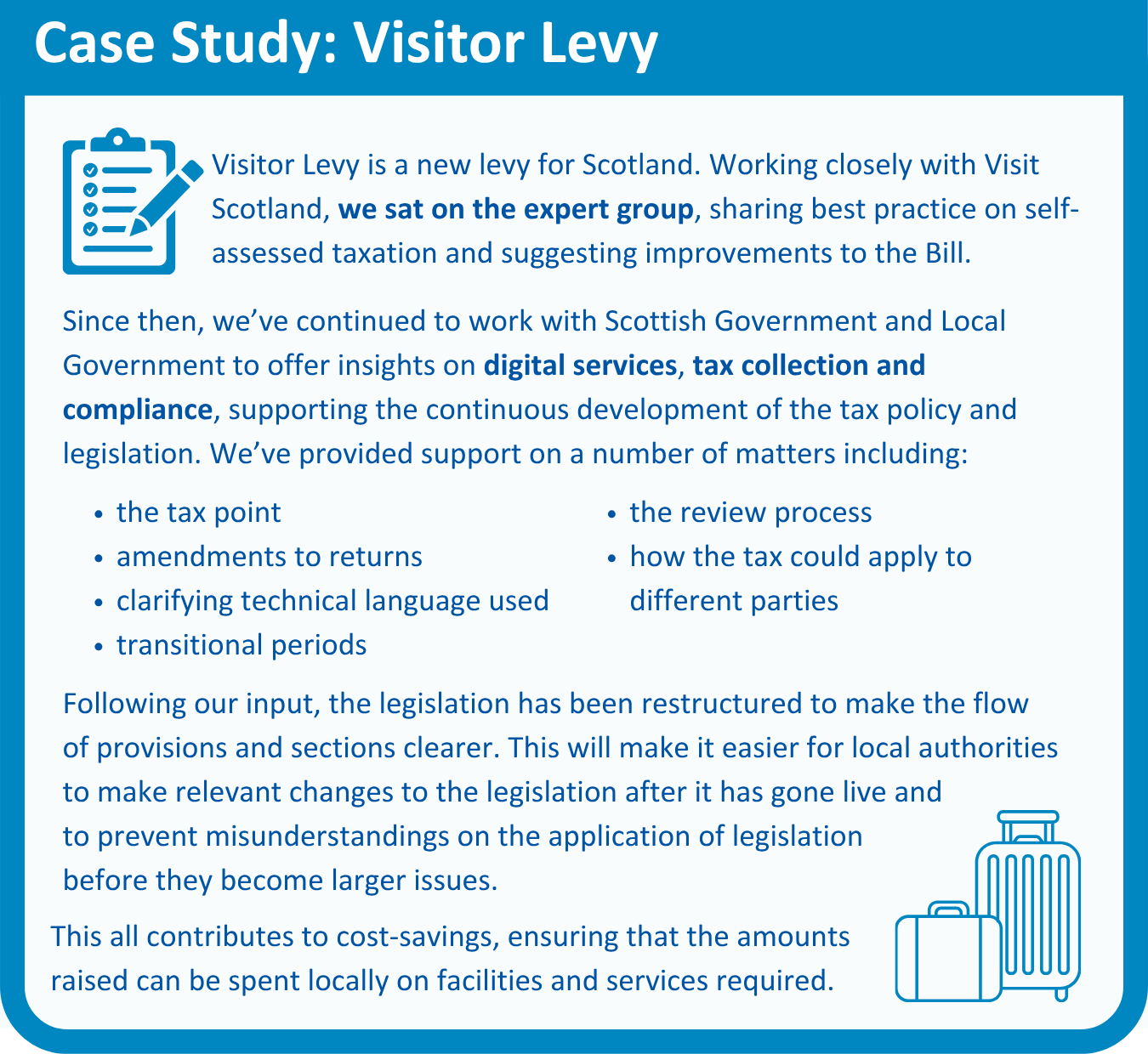
Visitor Levy is a new levy for Scotland. Working closely with Visit Scotland, we sat on the expert group, sharing best practice on self-assessed taxation and suggesting improvements to the Bill.
Since then, we’ve continued to work with Scottish Government and Local Government to offer insights on digital services, tax collection and compliance, supporting the continuous development of the tax policy and legislation. We’ve provided support on a number of matters including:
- the tax point
- amendments to returns
- clarifying technical language used
- transitional periods
- the review process
- how the tax could apply to different parties
Following our input, the legislation has been restructured to make the flow of provisions and sections clearer. This will make it easier for local authorities to make relevant changes to the legislation after it has gone live and to prevent misunderstandings on the application of legislation before they become larger issues.
This all contributes to cost-savings, ensuring that the amounts raised can be spent locally on facilities and services required.
As described above, we have been working with local government colleagues on the digital transformation of NDR and this work will be further developed in 2026–27.
Expanding Horizons Key Risks
If we fail to identify or influence policy change that impacts on the devolved tax system, our performance may be impacted.
It is vital we understand the legal framework in which we operate to ensure compliance with requirements and duties.
Key controls we have in place:
- Regular engagement with key partners across UK and Scottish Governments to ensure early notice of potential changes
- Horizon scanning across the tax landscape
- Monitoring issues as they arise and identifying learning points to feed back through communication channels
- Joint approach with Scottish Government to delivering change projects – legislation and its implementation treated as one joint project / programme
- Tax Partnership Board in place.
Failure to deliver new taxes means we fail to achieve the total tax revenues estimated in the Scottish budget.
Risk profile: High impact, medium likelihood
The ability to deliver new taxes is essential to our core statutory purpose of protecting and collecting tax revenues. We have a devolved taxes programme in place to manage the introduction of new taxes.
Key controls in place
- Devolved Taxes Programme in place with Tax Design staff
- SLT structured to allow a greater strategic focus on the delivery of key projects/programmes
- Close collaboration with SG around tax design
- Development arrangements with NEC
- Increased tax design capacity.