
The Director Report
Scottish Ministers appoint between five and nine members of the Revenue Scotland Board, in line with the Revenue Scotland and Tax Powers Act 2014 (RSTPA). One of these is appointed by Ministers as RS Chair.
Ministers determine the period and terms of appointment of Board members and may re-appoint individuals who already are, or have been, on the Board, subject to evidence of effective performance and their continued possession of the skills, knowledge and experience required by the Board. Appointments are made following a public appointments exercise regulated by the Commissioner for Ethical Standards in Public Life in Scotland.
Board Members 2025–26
We are led by the Chair, Aidan O’Carroll, together with the Chief Executive who is also the Accountable Officer. Elaine Lorimer served as Chief Executive until 23 November 2025. Johanna Boyd was appointed Chief Executive from 24 November 2025.
The Board collectively holds responsibility for directing the organisation’s major activities and strategic decisions. The following served on the Board during the reporting year 1 April 2025 to 31 March 2026. Where applicable, dates of appointment/tenure are shown.
| Name | Board Role | Term of Appointment |
|---|---|---|
| Aidan O’Carroll | Chair | 1 August 2021 – 31 July 2027 |
| Simon Cunningham | Board Member | 1 January 2021 – 31 December 2027 |
| Jean Lindsay | Board Member | 1 July 2019 – 30 June 2026 |
| Lord Ken Macintosh | Board Member | 1 June 2022 – 31 May 2028 |
| Alison Macdonald | Board Member | 1 July 2025 – 30 June 2028 |
| Robert MacIntosh | Board Member | 1 June 2022 – 31 May 2028 |
| Martin McEwen | Board Member | 1 July 2019 – 30 June 2025 |
| Idong Usoro | Board Member | 1 June 2022 – 31 May 2028 |
| Gillan Wheeler | Board Member | 1 July 2025 – 30 June 2028 |
Co-opted committee members
| Name | Term of Appointment |
|---|---|
| Elizabeth Barnes | 3 February 2025 – 4 February 2028 |
| Julie Hesketh-Laird | 3 February 2025 – 4 February 2028 |
| Stephen Ramsay | 3 February 2025 – 4 February 2028 |
Biographies of the Board members and Co-opted committee members can be found on our website. Details of company directorships and other significant interests held by members of the Board, which may give rise to a conflict of interest, are maintained in the organisation’s Register of Interests.
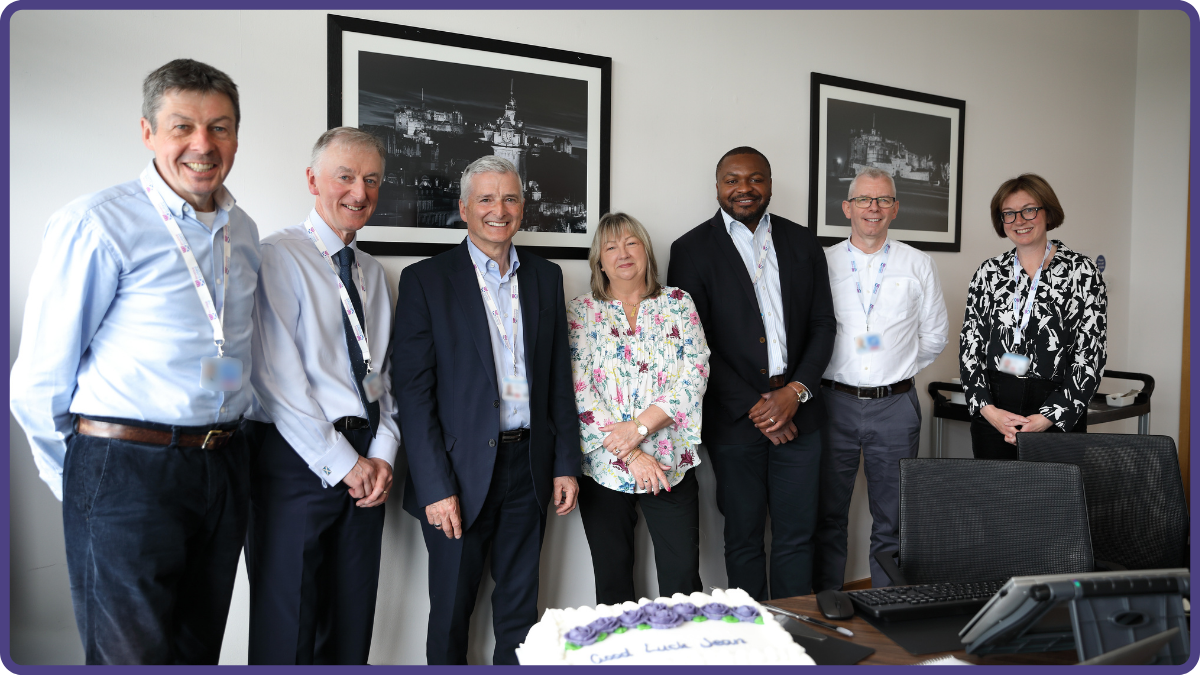
Senior Leadership Team
Biographies of the Senior Leadership Team can be found on our website.
- Johanna Boyd, Chief Executive, November 2025 – Present
- Elaine Lorimer, Chief Executive, March 2016 – November 2025
- Michael Paterson, Head of Tax, March 2019 – Present
- Neil Ferguson, Head of Corporate Functions, January 2016 – Present
- Mairi Gibson, Head of Legal Services, February 2020 – Present
Statement of the Accountable Officer’s Responsibilities
Under section 19(4) of the Public Finance and Accountability (Scotland) Act 2000, Scottish Ministers have directed Revenue Scotland to prepare for each financial year a statement of accounts in the form and on the basis set out in the Accounts Direction. The accounts are prepared on an accruals basis and must give a true and fair view of the state of affairs of Revenue Scotland and of its income and expenditure, Statement of Financial Position and cash flows for the financial year.
In preparing the accounts I, as the Accountable Officer, am required to comply with the requirements of the Government Financial Reporting Manual (FReM) and to:
- observe the Accounts Direction issued by Scottish Ministers, including the relevant accounting and disclosure requirements, and apply suitable accounting policies on a consistent basis;
- make judgements and estimates on a reasonable basis;
- state whether applicable accounting standards as set out in the Government Financial Reporting Manual have been followed, and disclose and explain any material departures in the financial statements;
- prepare the financial statements on a going concern basis; and
- confirm that the Annual Report and Accounts as a whole is fair, balanced and understandable. The Accountable Officer takes personal responsibility for the Annual Report and Accounts and the judgements required for determining that it is fair, balanced and understandable.
The Permanent Secretary of the Scottish Government (SG), who is the Principal Accountable Officer for the Scottish Administration has designated, in accordance with sections 14 and 15 of the Public Finance and Accountability (Scotland) Act 2000, the Chief Executive of Revenue Scotland as Accountable Officer for Revenue Scotland.
The responsibilities of an Accountable Officer, including responsibility for the propriety and regularity of the public finances for which they are answerable, for keeping proper records and for safeguarding our assets, are set out in the Scottish Public Finance Manual.
The Accountable Officer may consult with the Scottish Government Chief Financial Officer (CFO) on any aspects of the duties applying to Accountable Officers in the Scottish Administration.
The Accountable Officer must consult the CFO on any action which they consider is inconsistent with their duties on financial, regulatory or propriety grounds and specifically where they seek written authority from the Scottish Ministers or a direction from the Board of Revenue Scotland. In practice, the Chief Executive will delegate authority widely to other employees of Revenue Scotland but cannot, on that account, disclaim responsibility. The Chief Executive is responsible for informing the Principal Accountable Officer about any complaints about Revenue Scotland accepted by the Scottish Public Services Ombudsman (SPSO) for investigation and about the response to any subsequent recommendations from the SPSO.
As the Accountable Officer, I confirm that I have taken all the steps that I ought to have taken to make myself aware of any relevant audit information and to establish that Revenue Scotland’s auditors are aware of that information. So far as I am aware, there is no relevant audit information of which the auditors are unaware.
I confirm that this Annual Report and Accounts, taken as a whole, is fair, balanced and understandable, and I take personal responsibility for the Annual Report and Accounts and the judgements required for determining that it is fair, balanced and understandable.
Governance Statement and Framework
Revenue Scotland is responsible for the collection and management of Scotland’s devolved taxes. The relevant powers and duties of Revenue Scotland, and of the Scottish Ministers are set out in the Revenue Scotland and Tax Powers Act 2014.
Scottish Ministers are responsible for appointing the Board of Revenue Scotland following a public appointment exercise, regulated by the Commissioner for Ethical Standards in Public Life in Scotland.
Ministers must not direct or otherwise seek to control Revenue Scotland in the exercise of its functions but they may give guidance. This guidance must be published and laid before the Scottish Parliament unless Ministers consider that to do so would prejudice the effective exercise by Revenue Scotland of its functions. Scottish Ministers are responsible for setting rates, bands and thresholds relating to the devolved taxes, subject to the approval of the Scottish Parliament.
The Board of Revenue Scotland is collectively responsible for the leadership and direction of the organisation and for ensuring that it carries out its statutory functions effectively and efficiently. It may delegate any of its functions to an individual Board member, a committee of the Board, the Chief Executive, or any other staff member, but it will retain its responsibility for carrying out its function.
As the Chief Executive of Revenue Scotland, I am accountable to the Board of Revenue Scotland for the day-to-day running of the organisation and its operational performance. In this role, I seek assurance that appropriate controls are in place across the organisation, and in respect of the partners whom we rely on to support us in delivering our objectives. I can confirm that these have been in operation during 2025-26 and to the date of signing these accounts. I am supported by the Senior Leadership Team (SLT), who oversee the day-to-day business of Revenue Scotland, with each member taking responsibility for a specific area. The members of SLT are the Chief Executive, the Head of Tax, the Head of Corporate Functions and the Head of Legal Services.
Operation of the Board and Committees
The Board is responsible for the functions and powers of Revenue Scotland and delegates authority to staff through a Scheme of Internal Delegation. The Board sets the strategic direction for the organisation, oversees Revenue Scotland’s work and monitors performance including the design and operation of risk and governance frameworks. It does this through scrutiny and, where appropriate, approval of:
- Corporate Plans and Business Plans
- key strategies and policies
- regular reports, including reports relating to risk management, corporate performance, tax compliance, staff, health, safety and wellbeing, changes in the devolved taxes, progress on the introduction of new taxes
- scrutiny of the Annual Reports and Accounts
- reports from the Audit and Risk Committee and Staffing and Equalities Committee
- strategic engagement with key partners and service users.
During the year the Board reviewed the effectiveness of Revenue Scotland’s risk management and internal control arrangements. Based on the work of the Audit and Risk Committee, internal audit, external audit, senior leadership assurance, and management reporting, the Accountable Officer is satisfied that systems operated effectively throughout the year and up to the date of approval of these accounts. Where areas for improvement were identified, appropriate actions have been agreed and monitored through the Audit and Risk Committee.
Revenue Scotland’s governance, assurance and risk management arrangements comply with the relevant requirements of the Scottish Public Finance Manual, the principles of the UK Corporate Governance Code as applicable to public bodies, and the Scottish Government’s Risk Management Guide (Orange Book). No significant departures occurred during the year. For further details about the Board and its statutory functions, this can be found on our website.
The Board is supported by two Board sub-committees, the Audit and Risk Committee (ARC) and the Staffing and Equalities Committee (SEC).
Audit and Risk Committee
The Audit and Risk Committee supports the Board and the Accountable Officer by reviewing the comprehensiveness, reliability and integrity of the assurances that underpin the Annual Report and Accounts. The Committee’s remit, as set out in its published terms of reference within our Board Standing Orders, includes oversight of risk management, financial reporting, internal control and audit activity.
The work of the Committee and its membership can be found on our website.
Staffing and Equalities Committee
The Staffing and Equalities Committee supports the Board in ensuring that Revenue Scotland maintains effective arrangements for workforce planning, organisational capability, staff wellbeing, equality, diversity and inclusion, and compliance with relevant employment policies and statutory duties. The Committee’s remit, as set out in its published terms of reference within our Board Standing Orders, includes oversight of people strategies, monitoring workforce data and trends, and providing assurance on the effectiveness of policies and practices that support staff and promote an inclusive working environment.
The work of the Committee and its membership can be found on our website.
Assurances Provided to the Accountable Officer
I have received written assurances from my Heads of Service, who have responsibility for the operation and effectiveness of internal controls within Revenue Scotland’s Tax, Legal and Corporate Functions teams. No significant issues were raised with me by my Heads of Service.
The certificate prepared by the Head of Corporate Functions makes reference to the actions taken throughout the year to address financial control issues identified by Audit Scotland during 2024–25. I am pleased to report that the issues were all addressed during the year. An internal audit assurance review, conducted during the first quarter of 2026–27, has subsequently provided me with further assurance that the actions we have taken have been effective and identified three areas for further improvement that we will complete during 2026–27. I am confident our finance function and processes are stronger as a result of the work undertaken and I am extremely grateful to all staff involved in this work.
I also receive copies of the certificates of assurance provided to the Scottish Government’s Director-General Corporate, produced to support the assurances she provides to the Principal Accountable Officer in respect of the Scottish Government’s digital, financial, and people services. These are shared with me as some aspects of these are relevant to the services we receive from the Scottish Government as a shared service. No significant issues were raised with me.
The certificate from the Scottish Government’s Director of Corporate Operations raised a number of issues in respect of controls related to the SCOTS network and the digital services provided to Revenue Scotland by the Scottish Government. Having sought assurances from my Head of Data and Digital and Head of IT, I am content that these issues are not currently impacting negatively on the services that Revenue Scotland receives. We will, however, continue to engage closely with Scottish Government and monitor this issue going forwards.
Both the certificates from the SG’s Financial Management Directorate and People Directorate made reference to the implementation of the Oracle Cloud platform across SG and 32 public sector organisations. Last year’s annual report and accounts reported some of the transitional issues experienced in moving to the new system. I am pleased to report that the issues previously identified have been addressed and that Oracle is now embedded within the organisation, with any ongoing operational issues being only minor in nature. We continue to work closely with the Scottish Government to support ongoing improvements to the system and to maximise the benefits of the system and ensure it meets Revenue Scotland’s current and future needs.
The Accountable Officer of SEPA has provided me with assurance in respect of the statutory functions delegated to SEPA by Revenue Scotland. No significant issues were raised with me by SEPA.
No other significant matters were raised with me.
In conclusion, I can confirm that, based on the aforementioned written assurances received, there were no significant control weaknesses identified in the period under review.
Reports on Personal Data Incidents
There were no data breaches during the period that required escalation to the ICO. The wider corporate performance section of this report contains full details of data incidents and breaches.
Parliamentary Scrutiny
As a Non-Ministerial Office, Revenue Scotland is accountable to the Scottish Parliament and, as such, can be called to appear before parliamentary committees to provide updates on operational matters, give evidence on tax related matters or provide written statements.
During 2025–26, Revenue Scotland was held to account by Parliament. Our Chair and CEO appeared before Parliament on 18 November 2025 to provide evidence on our performance in 2024–25 and to support scrutiny of the Scottish Building Safety Levy (SBSL).
Revenue Scotland’s supporting legislation, our Corporate Plan, and this Annual Report are all publicly available documents. The Corporate Plan 2024–27, on which this document reports, was approved by Scottish Ministers and laid before the Scottish Parliament on 28 March 2024, and this report will be laid before Parliament in October 2026. Corporate plans, all annual reports and accounts, and minutes of Revenue Scotland Board meetings are available in the Corporate Documents section on our website.
Internal Audit
The Scottish Government’s Directorate for Internal Audit and Assurance (DIAA) provide Revenue Scotland’s internal audit service through a shared service arrangement with the Scottish Government. DIAA produce an annual audit plan which is reviewed by the Audit and Risk Committee, who provide advice on the plan to the Board and the Accountable Officer. Regular updates on progress against the audit plan are presented by DIAA to the Audit and Risk Committee’s meetings.
During the year, DIAA completed audits on the following:
Finance (Internal Processes and Controls)
This advisory review of finance controls and processes was commissioned by the Chief Executive/Accountable Officer to investigate the issues identified in the Audit Scotland Interim Management letter issued on 14 May 2025.
The review identified 16 medium priority recommendations which were addressed during the year.
This was the first phase of assurance work undertaken by Internal Audit. A second phase was undertaken during Q1 2026–27. This assurance review assessed whether the improvements agreed at phase one had been implemented and were operating effectively. This second review is referenced within the Assurances Provided to the Accountable Officer section above.
Debt Collection
This advisory review examined Revenue Scotland’s process of reviewing debt collection and considered whether the current arrangements were efficient, effective and provided added value.
Four medium priority recommendations and four low priority recommendations were identified and are being addressed.
This was the first phase of work, which evaluated and reported on the controls in place to manage the risk surrounding RS debt collection arrangements. A second phase will follow in 2026-27 and will be an assurance review that will assess whether the process improvements agreed at phase one have been implemented and are operating effectively.
Tax Governance Framework
This review examined whether tax governance arrangements, project management operations and staff capability were robust and aligned with Revenue Scotland’s statutory purpose of protecting and collecting tax revenues. The review provided assurance over risks around protecting the integrity of the tax system and the delivery of New Taxes.
A ‘Substantial’ assurance rating was awarded, recognising that risk, governance and control procedures are effective in supporting the delivery of objectives. No recommendations for further improvement were proposed in relation to this review.
The review commended the governance structures in place within RS, including the Tax Governance Framework and delegation of authority, which were well documented and provided clear accountability and effective oversight. In addition, programme and project management practices for the new taxes were seen to be robust with clear milestones and effective risk management.
Annual Assurance Opinion 2025–26
The overall annual assurance opinion provided by DIAA for 2025–26 was ‘Substantial’ assurance. This reflects DIAA’s opinion that Revenue Scotland’s risk, governance and control procedures remain effective in supporting the delivery of its objectives and that any exposure to potential weakness is low and the materiality of any consequent risks negligible. DIAA reported that the culture within Revenue Scotland continues to be open to audit and assurance, with the RS Senior Leadership Team engaging with designated DIAA contacts on key strategic and operational matters.
External Audit
External Audit is provided by Audit Scotland. The Audit Director is appointed under the Public Finance and Accountability (Scotland) Act 2000 to carry out the audit of Revenue Scotland’s Annual Report and Accounts. During the year, the Audit and Risk Committee scrutinised Audit Scotland’s audit plan and received regular updates from them.
As part of the 2024–25 audit undertaken by Audit Scotland, there were three recommendations: for the scope for medium term financial planning arrangements to be developed further to highlight and ensure financial sustainability; implement a process to formally document its annual impairment review of non-current assets; and ensure robust succession planning arrangements are in place for the finance team to protect the capability and capacity of this core function. Action was taken during 2025–26 to address these matters.
As part of the 2025–26 audit process, Audit Scotland issued an interim audit management letter in June 2026. This summarised the audit work they had undertaken during their 2025–26 interim audit of Revenue Scotland and identified some potential risks related to: authorisation of journal entries; bank adjustment journals; user access to the general ledger; reconciliations, controls over repayments and exception reporting and accruals. Action was taken to address all of these risks and was reviewed by Audit Scotland as part of the 2025-26 audit.
Assessment of Corporate Governance
Revenue Scotland has in place a system of internal controls and policies which are designed to safeguard its assets, data, and ensure the reliability of financial records in relation to operational and tax duties.
I ensure that these controls are subject to regular review by management. Our internal controls also undergo formal review by both Internal and External Audit, whose reports are made available to the Audit and Risk Committee. Having assessed our corporate governance arrangements, I confirm that they comply with generally accepted best practice principles and relevant guidance.
Risk Management
I have assessed our risk management arrangements and confirm that they are in accordance with the guidance set out in the Scottish Public Finance Manual. The year-end Certificates of Assurance include a dedicated section assessing the effectiveness of Revenue Scotland’s risk management approach over the year and no significant control matters were raised. This, alongside the detailed review of the Corporate Risk Register undertaken with our Risk owners and Audit and Risk Committee throughout the year, contributes to my overall confidence assessment offered; further confirming that robust arrangements and practices were in operation throughout 2025–26.