
Performance Overview
Introduction
The Performance Overview outlines our organisational purpose, vision, structure and the work we do to achieve our strategic objectives set out in our Corporate Plan. It demonstrates how this work aligns with the National Outcomes set out in the Scottish Government National Performance Framework. This section also looks at the key risks, tax compliance activity and financial performance during the 2025–26 financial year.
Who we are and what we do
Revenue Scotland was established under the Revenue Scotland and Tax Powers Act 2014 (RSTPA 2014). We are responsible for the collection and management of the fully devolved Scottish taxes, which as of end of 2025–26 are:
- Land and Buildings Transaction Tax (LBTT)
- Scottish Landfill Tax (SLfT)
This and the coming years will see the introduction of new devolved taxes:
- Scottish Aggregates Tax (SAT) – introduced in April 2026
- Air Departure Tax (ADT) – April 2027
- Scottish Building Safety Levy (SBSL) – expected 2028
As a Non-Ministerial Office and a Crown Body, we are part of the Scottish Administration and we are accountable directly to the Scottish Parliament, ensuring the impartial administration of taxes. Based on our operational experience, we provide policy development support through the provision of advice, data and information to the Scottish Government which is responsible for tax policy and the setting of tax rates and bands.
We are also proud to work alongside the Scottish Fiscal Commission (SFC), which is responsible for providing independent forecasts of tax revenue in line with the Fiscal Framework. To aid forecasting work, we provide anonymous, aggregated SLfT and LBTT data to the SFC.
We delegate specific functions for SLfT collection to the Scottish Environment Protection Agency (SEPA) and collaborate with His Majesty’s Revenue and Customs (HMRC) on tax compliance activity.
The Devolved Tax Accounts, published alongside these Resource Accounts, demonstrate the value achieved by Revenue Scotland in the operation of the Devolved Taxes. Together they contain all the financial accounts relating to tax spend and the Financial Reporting Manual (FREM) accountability requirements.
The Resource Accounts contain the majority of the FREM requirements such as the organisation's main performance and accountability reporting alongside our Financial Accounts for resource spend (non-tax spend such as staff and IT). However, the Performance and Accountability Reports will reference tax processes and outcomes and draw on numbers from the tax accounts.
Purpose and vision
Our Purpose and Vision are set out in our Corporate Plan 2024-27, which sets out our aspirations for the future, with a focus on four strategic outcomes which underpin our priorities for the next three years:
- Operational Excellence
- Investing in our People
- Working with Others
- Expanding Horizons
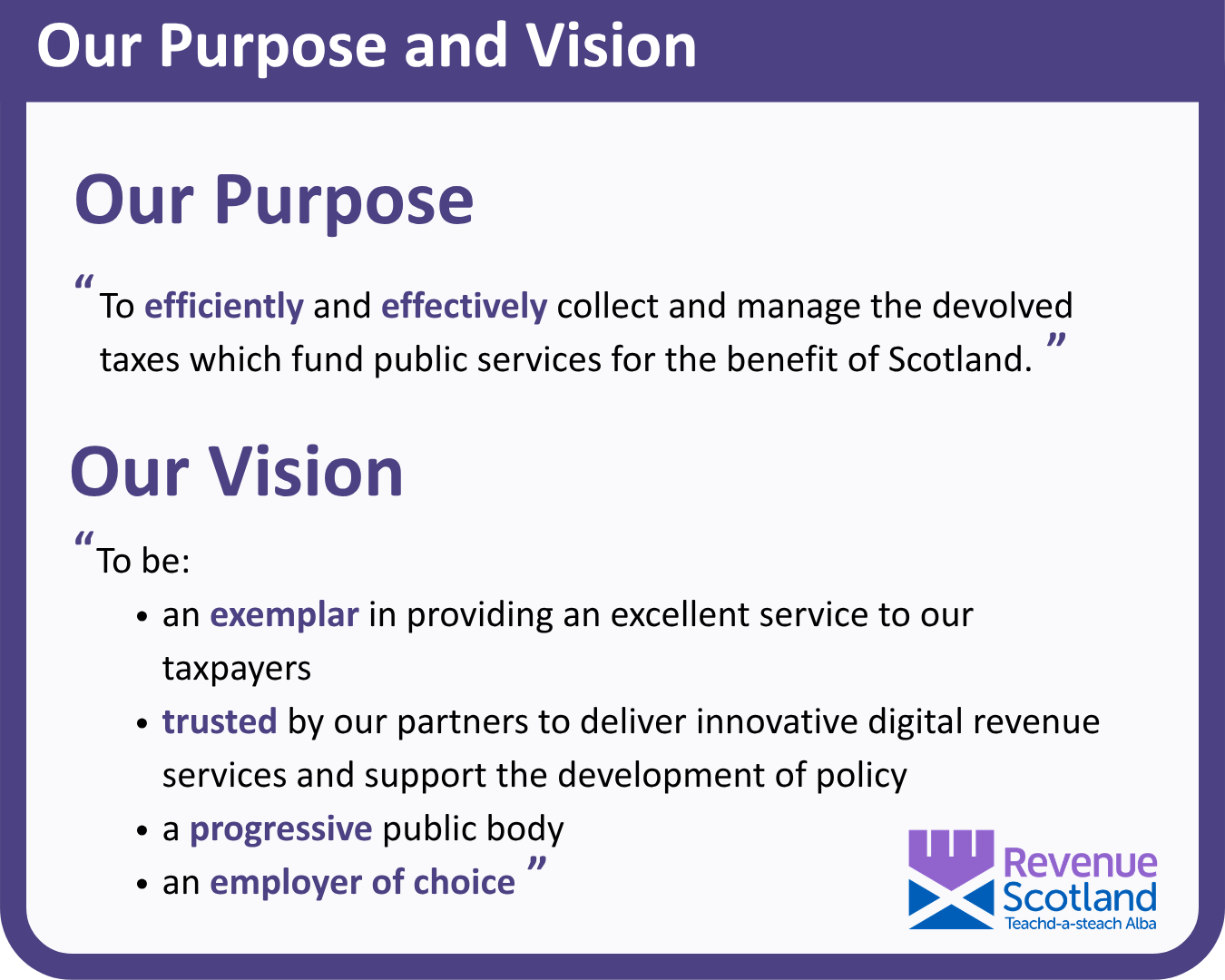
Our purpose: "To efficiently and effectively collect and manage the devolved taxes which fund public services for the benefit of Scotland."
Our vision: "To be:
- an exemplar in providing an excellent service to our taxpayers
- trusted by our partners to deliver innovative digital revenue services and support the development of policy
- a progressive public body
- an employer of choice"
National Performance Framework
The National Performance Framework (NPF) underpins the Scottish Government’s vision, setting out National Outcomes to measure progress towards its goals. Our Corporate Plan is aligned with these outcomes, guiding our efforts to support those relevant to our remit.
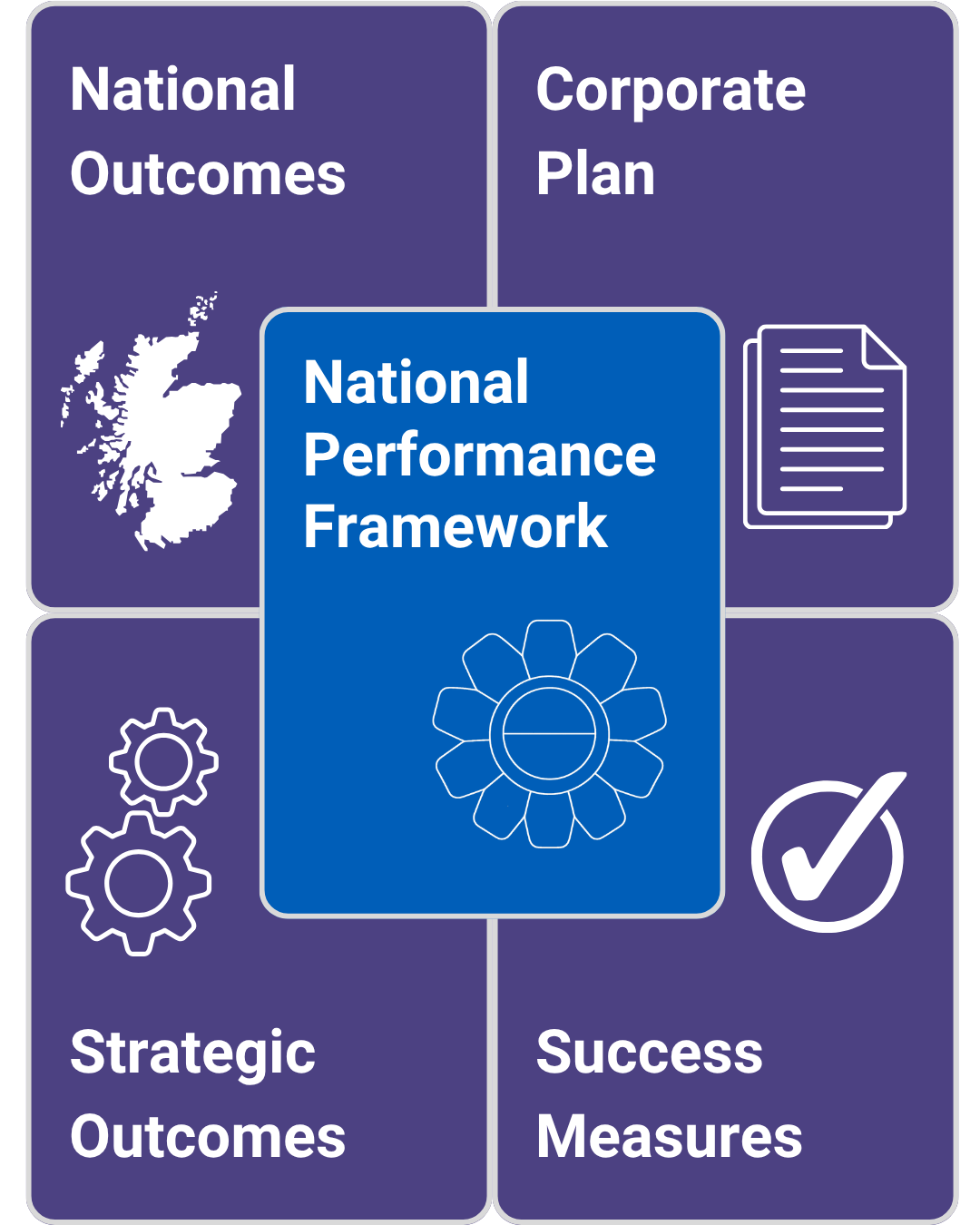
Four rectangles arranged in a grid; clockwise from top left, the labels on the rectangles read:
- National Outcomes
- Corporate Plan
- Success Measures
- Strategic Outcomes
In the centre, on top of the other rectangles, is a fifth rectangle, labelled National Performance Framework.
By collecting devolved taxes, we indirectly support all National Outcomes, and directly contribute to six specific areas:
- Economy
- Environment
- Fair work and business
- Communities
- Human rights
- Health
Our approach emphasises investment in our workforce, dedication to equality, diversity, and inclusion, and collaboration with various partners, all underpinned by transparency and accountability.
We are aware that the NPF is under review, with proposals presented to the Finance and Public Administration Committee (FPAC) by the Deputy First Minister in February 2026. We will continue to stay abreast of this review and adapt our approach where necessary when developing our Corporate Plan for 2027-30.
Organisational structure
The Board sets our strategy and direction and is supported by sub committees and the Executive. Our Chief Executive and Accountable Officer, Johanna Boyd, is accountable to the Board and leads delivery. Johanna is supported by the Senior Leadership Team who drive delivery across Tax, Corporate Functions and Legal Services.
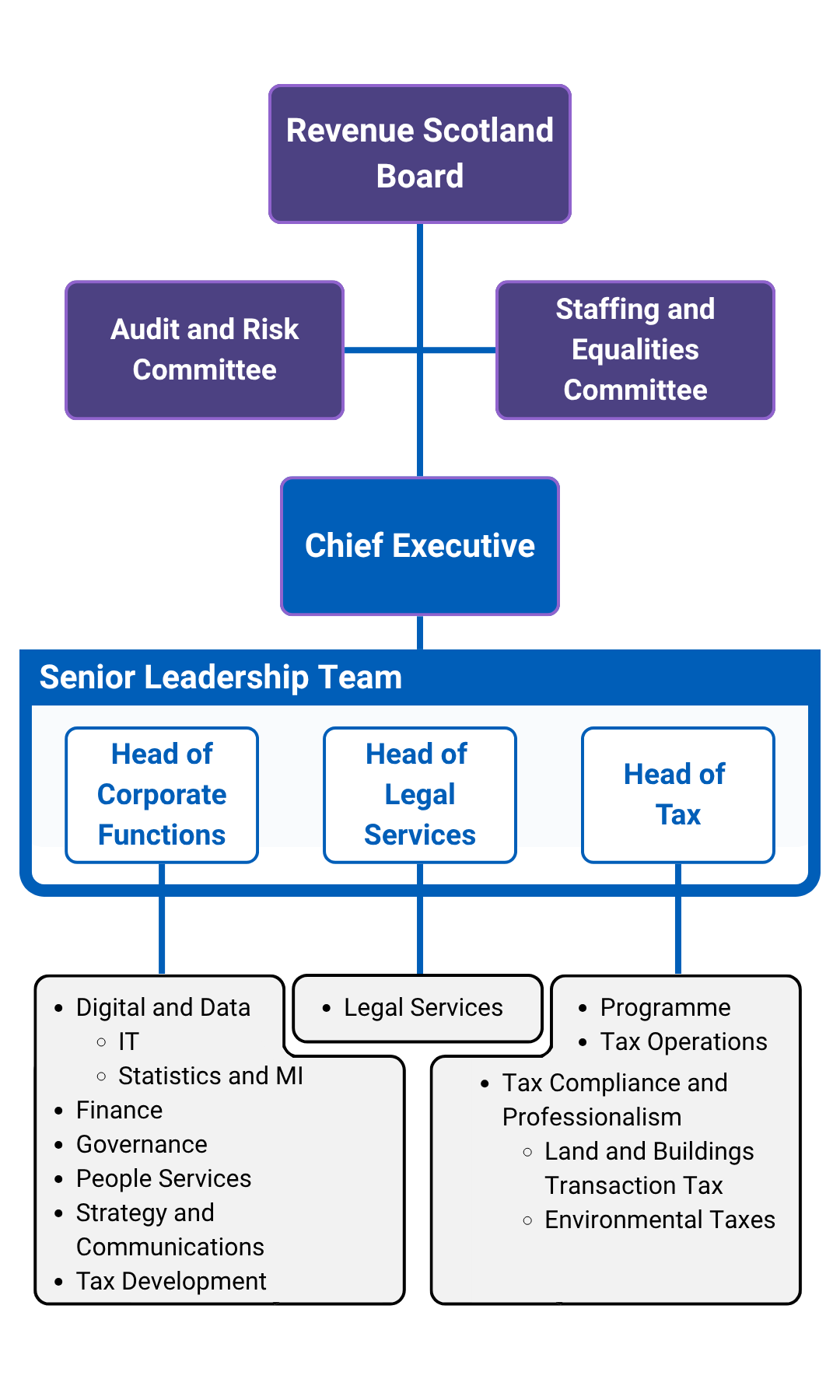
A structure diagram representing Revenue Scotland.
At the top of the diagram is the Revenue Scotland Board; below this is the Audit and Risk Committee and Staffing and Equalities Committee. Lines from these three connect to the Chief Executive.
From the Chief Executive, a line connects to a wider box labelled Senior Leadership Team. Inside this box are three titles: Head of Corporate Functions, Head of Legal Services and Head of Tax. Beneath each are the teams each is responsible for:
Head of Corporate Functions
- Digital and Data
- IT
- Statistics and MI
- Finance
- Governance
- People Services
- Strategy and Communications
- Tax Development
Head of Legal Services
- Legal Services
Head of Tax
- Programme
- Tax Operations
- Tax Compliance and Professionalism
- Land and Buildings Transaction Tax
- Environmental Taxes
To ensure we remain agile, forward-looking and ready to deliver our priorities while continuing to provide excellent services for Scotland, our organisational structure is being reviewed, and changes will be introduced during 2026-27. Most importantly, they build on the expertise, commitment and passion that already exists across the organisation.
Financial performance
Resource Accounts
| Net Expenditure Against Resource Budget | Original Budget - Resource and Non-Cash £000 | Autumn & Spring Budget Revision changes £000 | Post Spring Budget Revision Budget - Resource and Non Cash £000 | Total Actual - Resource and Non-Cash £000 | Underspend/(Overspend) | % Variance |
|---|---|---|---|---|---|---|
| 2025–26 | 10,213 | 250 | 10,463 | 10,205 | 258 | 2% |
| 2024–25 | 9,500 | (400) | 9,100 | 8,694 | 406 | 4% |
| Net Expenditure Against Capital Budget | Original Budget Capital £000 |
Autumn & Spring Budget Revision changes £000 | Post Spending Review Budget - Capital £000 |
Total Actual Capital £000 |
Underspend/(Overspend) | % Variance |
|---|---|---|---|---|---|---|
| 2025–26 | 1,750 | (900) | 850 | 867 | (17) | -2% |
| 2024–25 | 1,500 | (300) | 1,200 | 1,252 | (52) | -4% |
In 2025-26, revenue expenditure was £258,000 less than budget (2% of the total resource budget). This underspend was primarily due to setting aside £150,000 for potential higher estates charges in 2024-25 and 2025-26 that on further investigation was not required and a £68,000 revaluation credit from extending the use of the EPICOR finance system to align it with the end of the SETS IT system life cycle.
The £17,000 capital spend variance (2% of the total capital budget) is due to a rescheduling of the introduction of Air Departure Tax to April 2027, announced in the 2026-2027 Scottish Budget. We returned £900,000 capital budget to Scottish Government at Spring Budget Revision in November after a reprofiling of the SBSL timeline.
Devolved Taxes Accounts
The LBTT revenue collected is dependent on performance of both the residential and non-residential property markets within Scotland. The SLfT revenue collected is dependent upon categories and tonnage of waste deposited in landfill sites within Scotland.
Independent forecasts of LBTT and SLfT revenue are published by the Scottish Fiscal Commission (SFC). The SFC publishes forecast evaluation reports comparing outturn figures to Budget Act estimates, detailing the reasons for any differences observed. Revenue net of repayment, excluding interest payable and revenue losses.
| 2025–26 Tax, Penalties & interest receivable Total £000 |
2025–26 Budget Act Estimates* Total £000 |
2024–25 Tax, Penalties & interest receivable Total £000 |
|
|---|---|---|---|
| Land & Buildings Transaction Tax | 952,039 | 1,018,531 | 899,162 |
| Scottish Landfill Tax | 55,478 | 40,353 | 55,938 |
| Penalties & interest | 5,492 | 0 | 6,457 |
| Total | 1,013,009 | 1,058,883 | 961,557 |
*December 2024 SFC forecasts
The values in the above table are for tax returns and amendments submitted during 2025-26. They are adjusted for the value of LBTT and SLfT returns received during April and May 2026, which relate to the period up to March 2026.
The tax returns submitted during 2025-26 may include adjustments to returns originally submitted in previous financial years.
However, unless these adjustments were received in April or May of the relevant financial period and therefore accrued into the financial statements of that year, these are accounted for in the year of receipt.
A summary of the tax revenue and our resource spend over the period 2020-25 is shown at the end of the accounts.
Risk Summary
As of 31 March 2026, we had 12 risks on the Corporate Risk Register. A key focus during 2025–26 was cyber security and data protection which were the focus for our annual Business Continuity Exercise involving our leadership team. Resilience, and our ability to manage multiple changes have also been major priorities, with our Corporate Risk Register evolving to strengthen risk management in this area.
All of our risks are considered in detail in the Performance Analysis section of this report under each of the four strategic outcomes. Our risk management approach is covered in greater detail within the Corporate Performance and the Corporate Governance Report sections.
Public Service Reform (PSR)
In June 2025, the Scottish Government published the Public Service Reform Strategy. The strategy promotes efficiency of service delivery across the public sector through the lens of 18 workstreams.
Core to the strategy is the operating model of each public body. Since our establishment in 2015, our operating model has been well aligned with the direction of the strategy, supporting the digital delivery of services, shared corporate functions, and the effective use of data.
Our tax services are fully digital, with returns and payments made almost exclusively online through a single platform, the Scottish Electronic Tax System (SETS). Ongoing investment has enabled automation of high-volume processes, including standard taxpayer letters and notices.
We share corporate services with the Scottish Government, including procurement, HR and internal audit, and operate from shared offices in Edinburgh and Glasgow.
Under the Digital Economy Act 2017, we have agreements with a number of local authorities for the sharing of Non-Domestic Rates (NDR) data to support our LBTT tax compliance activity.
Consequently, we are a highly efficient tax authority, collecting around £1 billion annually, with collection costs consistently under the Organisation for Economic Co-operation and Development (OECD) benchmark of 1%.
Our remit is expanding as we take on responsibility for collecting additional devolved taxes, including SAT, SBSL and ADT, at the request of the Scottish Government. As our responsibilities grow, achieving the operating cost reductions envisaged by the strategy becomes increasingly challenging. Our focus is therefore on delivering these new responsibilities in a way that aligns with the objectives of the PSR strategy.
We will achieve this by:
- reusing existing digital infrastructure - SAT, ADT and SBSL will run on the existing SETS platform
- absorbing the new taxes into existing capabilities with only minimal increases in capacity.
Our proposals for reforming tax delivery in Scotland
The PSR Strategy encourages public bodies to be ambitious in considering ways in which public services could be run more efficiently in the future, making best use of advances in technology and data. Inspired by the PSR Strategy, we are developing two proposals to improve the efficiency of Scotland’s tax system:
- a tax platform in the form of a single online portal that would allow taxpayers to engage with a range of Scottish tax services. This will be considered further in 2026-27.
- a single online platform to support local authorities in their collection and management of Non-Domestic Rates. Following a workshop facilitated by Revenue Scotland, a working group led by the Improvement Service and involving a range of public bodies, including Revenue Scotland, has been established to consider the proposal for a single online platform for NDR further. We will continue to engage and advise on this work as it progresses.
Tax compliance activity
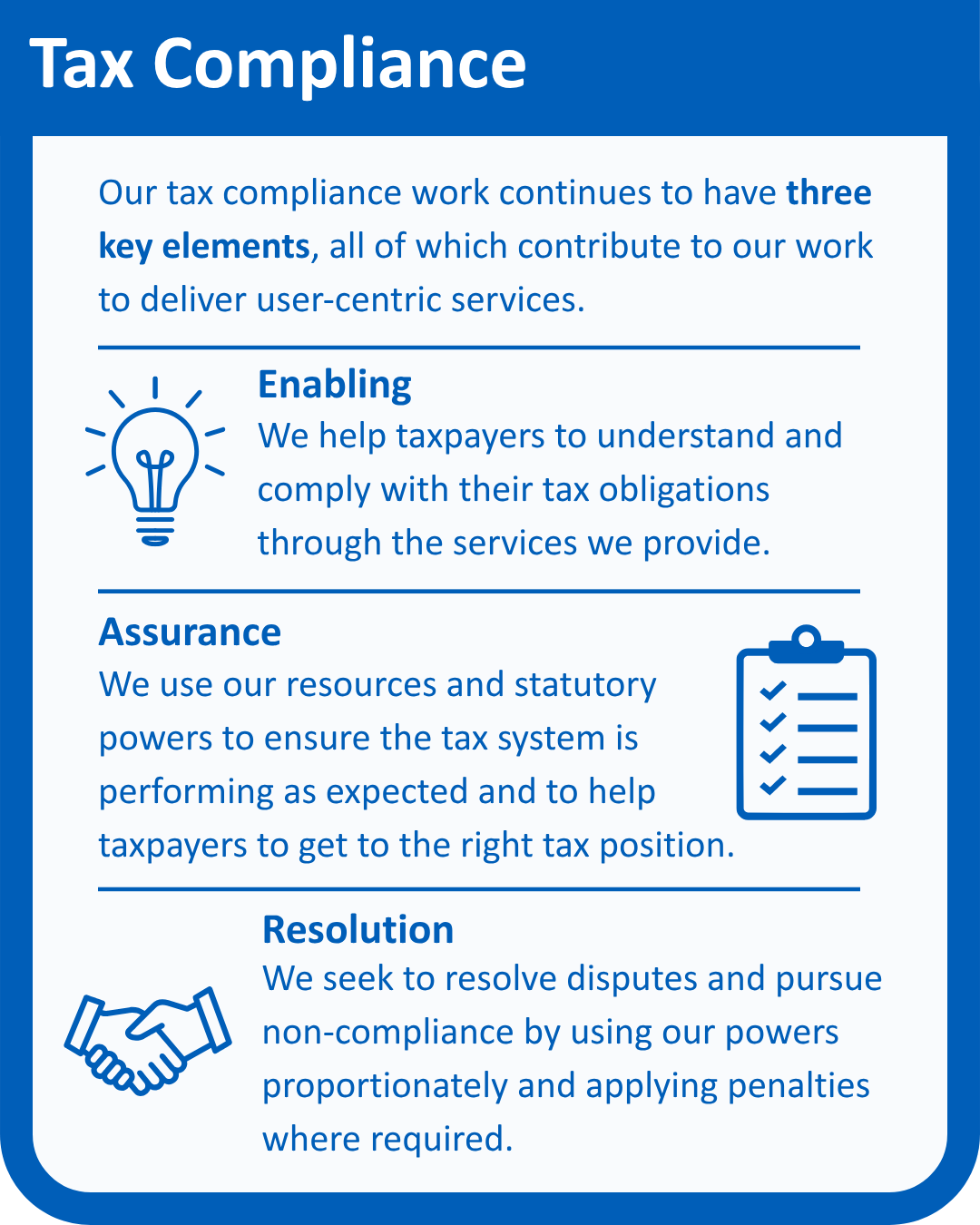
Our tax compliance work continues to have three key elements, all of which contribute to our work to deliver user-centric services.
Enabling: we help taxpayers to understand and comply with their tax obligations through the services we provide.
Assurance: we use our resources and statutory powers to ensure the tax system is performing as expected and to help taxpayers to get to the right tax position.
Resolution: we seek to resolve disputes and pursue non-compliance by using our powers proportionately and applying penalties where required.
Our compliance activities are guided by our published Approach to Tax Compliance and Settlement and Litigation Principles, which set out the principles underpinning our work and how we resolve tax disputes, as well as applying the agreed standards of behaviour as set out in our Charter of Standards and Values.
Where taxpayers dispute our decisions, we seek to resolve matters constructively and litigate responsibly. We also share relevant First-tier Tribunal for Scotland (FTTS) case law where appropriate to help taxpayers understand the basis for our decisions.
During 2025–26, our compliance activity secured £1,614,918 in tax revenue through additional tax identified and tax protected through the rejection of invalid repayment claims. This figure does not include the wider benefits of our preventative compliance work, such as improving guidance and enhancing SETS to reduce errors and support compliance.
We continue to work closely with HM Revenue and Customs (HMRC) and the Welsh Revenue Authority (WRA), sharing information, intelligence and good practice. We also explore opportunities to use data held across the public sector to strengthen compliance activity, including through powers provided by the Digital Economy Act 2017.
Alongside our operational work, we engage regularly with Scottish Government policy colleagues on potential legislative developments and maintain strong relationships with key stakeholders, including Association of Taxation Technicians (ATT), Chartered Institute of Taxation (CIOT), Convention of Scottish Local Authorities (COSLA), Institute of Chartered Accountants of Scotland (ICAS), Law Society of Scotland (LSS) and other industry bodies.
Tax disputes: reviews and appeals
We seek to minimise tax disputes through clear guidance and robust decision-making. Where disputes arise, taxpayers and their agents can request an internal review of a decision, pursue mediation, or appeal to the First-Tier Tax Chamber of Scotland (FTTS).
Taxpayers and their agents may request a review of decisions affecting liability, amounts due, payment dates or the application of penalties or interest. Reviews are carried out independently by an officer not involved in the original decision. The RSTPA 2014 defines which decisions are reviewable and appealable. The FTTS hears appeals against our decisions, with onward appeals on points of law heard by the Upper Tribunal for Scotland.
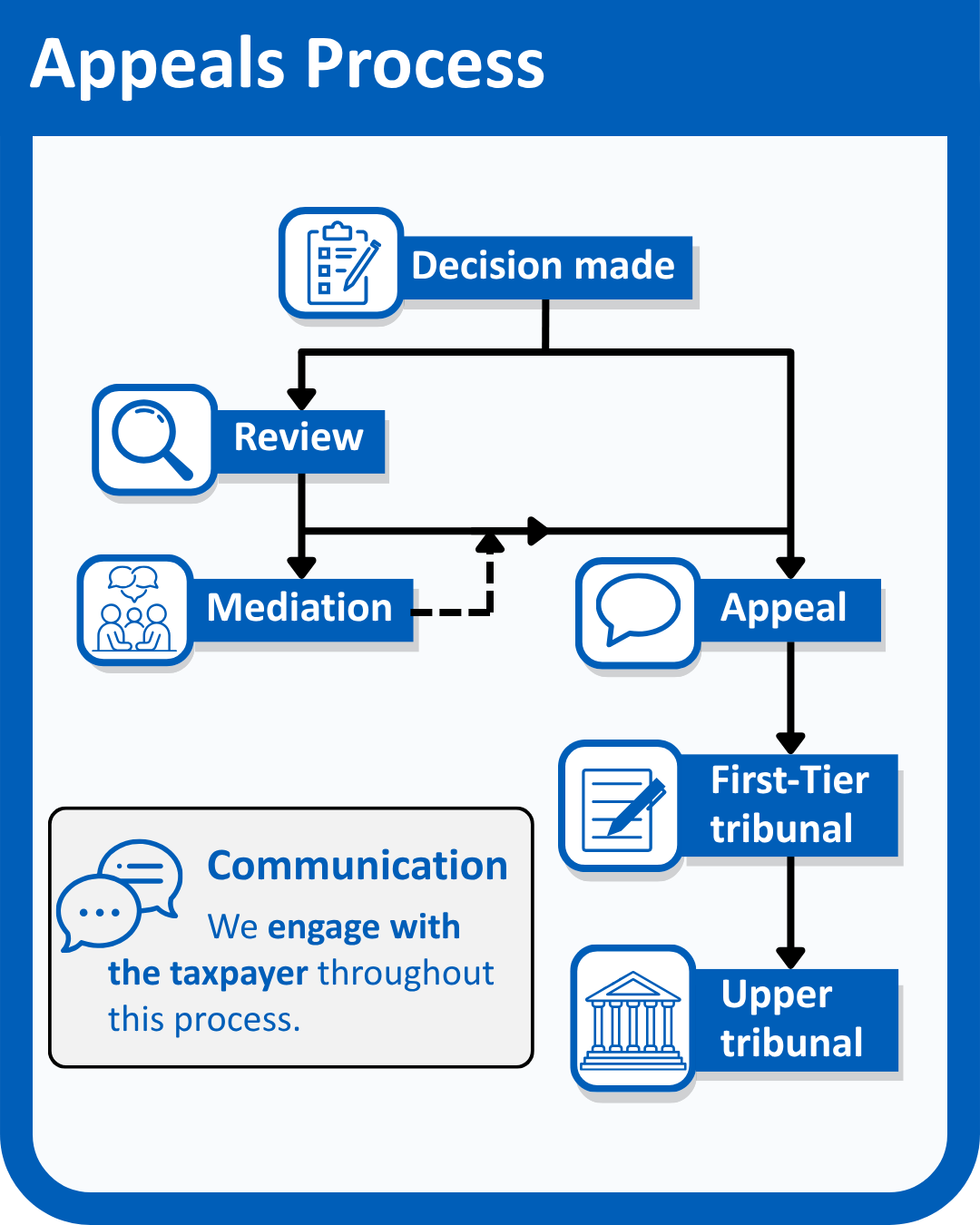
A flowchart of our appeals process.
The process begins with Decision made. This can either lead to Review or Appeal.
From Review, the process can either lead to Mediation or Appeal. A dotted line connects Mediation to Appeal.
Appeal leads to First-Tier tribunal, which in turn leads to Upper tribunal.
A callout box reads:
Communication: we discuss with the taxpayer throughout this process.
Reviews
In 2025–26, we received over 128,000 tax returns with only 661 resulting in a request for a review of decisions made. Of those concluded, we upheld the original decision in 393 cases. In some cases, new information provided during the review process resulted in the original decisions being revisited. In total we changed 230 decisions, varied 23 decisions, and the taxpayer withdrew 15 reviews.
Appeals
| Appeals | 2025–26 | 2024–25 | 2023–24 |
|---|---|---|---|
| New cases initiated | 21 | 29 | 23 |
| Cases decided | 15 | 12 | 6 |
| Cases Settled | 16 | 13 | 8 |
| Cases dismissed | 0 | 1 | 2 |
During 2025-26 21 FTTS appeals were initiated, including 6 involving the Additional Dwelling Supplement (ADS). This represents a decrease from the previous year, which may partly reflect greater clarity provided by Tribunal decisions on penalties. The reduction in LBTT appeals was primarily driven by a fall in ADS related cases and aligns with the expected downturn following legislative changes introduced on 1 April 2024.
We are proactive in identifying cases that are capable of being resolved without the need for a hearing or decision, but where one is required, we work to narrow the issues assisting both the Tribunal and the taxpayer in the process.
Resolving tax disputes through litigation
Litigation carries costs and risks for taxpayers and the public purse, so we work to minimise disputes through proactive support. This includes providing guidance, webinars, opinion services, support desks, direct contact with caseworkers, and upholding our Charter of Standards and Values.
As devolved taxes are self-assessed, taxpayers are responsible for calculating the tax due. Where we disagree with an assessment, or no return has been submitted, we may determine the amount due. In 2025–26, our collaborative approach with taxpayers resulted in six appeals being settled while protecting revenue.
Disputes can identify common legislative issues and opportunities to improve the tax system. We support Scottish Government colleagues where legislative changes are needed and use lessons learned from disputes to drive continuous improvement.
Consumer Duty
We are a relevant public authority under The Consumer Scotland Act 2020 (Relevant Public Authorities) Regulations 2024. This means that we must meet the following duties set out in the 2020 Act:
- when making decisions of a strategic nature, we must have regard to the impact those decisions have on consumers in Scotland
- when making decisions of a strategic nature, we must have regard to the desirability of reducing harm to consumers in Scotland
- we must publish information about the steps taken to meet the Consumer Duty
- we must have regard to the Consumer Scotland guidance on how to meet the Consumer Duty.
We have met all the requirements of the 2020 Act during 2025–26. This was achieved through:
- the review of our impact assessment process and associated guidance for our staff to ensure that this covers the Consumer Duty
- the creation of a new Integrated Impact Assessment Tool and screening document
- the amendment of our templates for Board and Committee papers, to capture strategic decisions and ensure that every paper considers whether or not an impact assessment is required and details why this was (or was not) the case
- inclusion of reporting on the Consumer Duty within our annual report and accounts.
We considered the Consumer Duty and all other relevant equality duties throughout our service delivery.
This included the development of the electronic communications consultation document which was drafted by Revenue Scotland and the Scottish Government. We met with various public sector organisations such as HMRC and Social Security Scotland to understand their adoption of electronic communications and how this impacted their customers. We considered how the proposed changes may impact on consumers in Scotland and explored the case for providing that service by ordinary post could be used, where consumers opt out of receiving electronic communications or are “digitally excluded”.
During the design and implementation of SAT, extensive engagement was undertaken with the industry to introduce Revenue Scotland and to provide the rationale for additional data requirements. The project team used insight gathered from taxpayers to design an approach for the submission of multiple returns and provided targeted support to ensure taxpayers were registered and submitted initial returns on time.
We also carefully incorporated accessibility and equality considerations into the design of customer communications, processes, and service improvements. This means that we have put consumer outcomes at the heart of our strategic decision making by having regard to the impact those decisions have on consumers in Scotland and to the desirability of reducing harm to such consumers.